Why BI Platforms Fail Enterprises in 2026
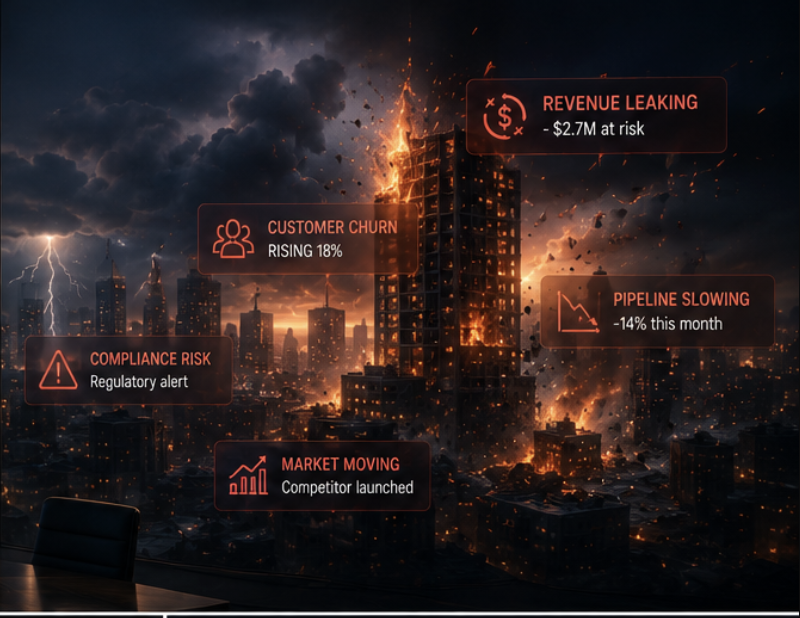
BI platforms failing enterprises occurs when static dashboards cannot synthesise multi-source signals fast enough to inform decisions that carry material financial, operational, or regulatory consequences.
What does “BI platforms failing enterprises” actually mean in 2026?
Business intelligence platforms were designed to answer questions executives already knew to ask. They aggregate historical data, render it visually, and wait. In 2026, that architecture is a structural mismatch for enterprises operating in markets where conditions shift faster than quarterly reporting cycles. The failure is not cosmetic. When a board asks whether the company is AI-ready, a dashboard showing last quarter's KPIs does not answer the question. When a pipeline is stalling, a static funnel chart identifies the symptom but not the cause. The gap between data rendered and decision made is where enterprise value erodes.
Why is data latency still the core problem in enterprise BI?
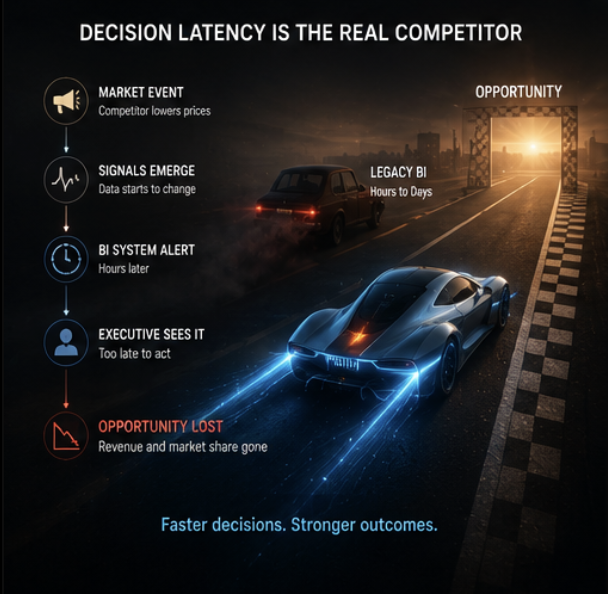
Data latency in BI platforms is the delay between an event occurring in the business and that event becoming visible and actionable in a reporting interface. In most enterprise deployments, that delay ranges from hours to days. According to Gartner's 2025 Data and Analytics Summit Report, 68% of enterprise data and analytics leaders report that decision latency — the time from data availability to executive action — remains their primary barrier to competitive advantage. Tableau, Power BI, Domo, and ThoughtSpot all address visualisation speed. None of them address decision speed. Rendering a chart faster does not close the gap between a signal appearing in data and a leader understanding what it requires them to do next. The latency problem in 2026 is not technical — it is contextual.
How do traditional BI tools fail at contextual decision making?
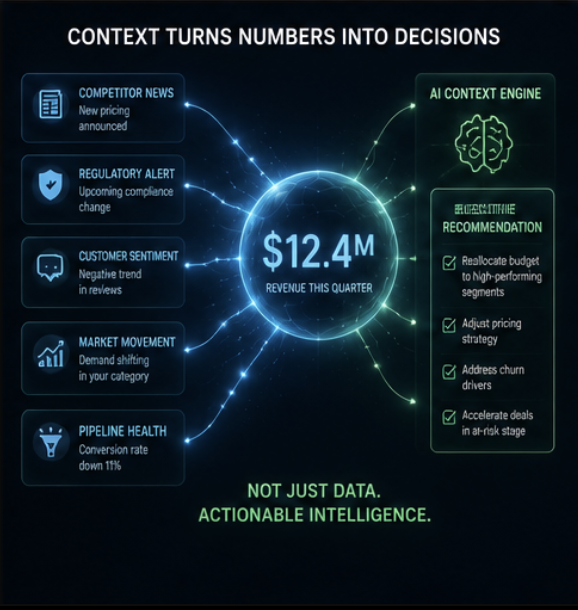
Context is what separates a number from an insight. A revenue figure means nothing without knowing the target, the trend, the external conditions affecting it, and the decision it should inform. BI platforms surface the number. They do not supply the context. McKinsey's 2025 State of AI in the Enterprise report found that organisations with contextual AI integrated into decision workflows were 2.4 times more likely to report faster time-to-decision at the executive level compared to those using visualisation-only tools. For a CFO preparing a board presentation on AI readiness, Tableau can show spend. It cannot show whether that spend is positioning the company relative to competitors, or whether the allocation is coherent with the stated strategy. That contextual synthesis is the gap that static BI cannot close.
Why do BI platforms struggle to synthesise signals across data sources?
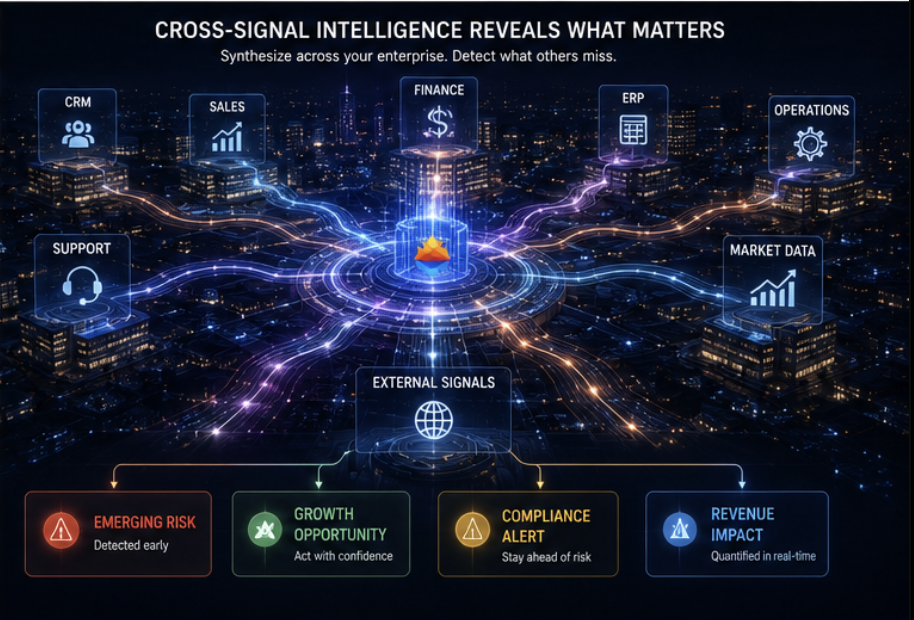
Modern enterprises generate signals across CRM systems, financial platforms, support queues, market data feeds, and operational tools simultaneously. The value is in the synthesis — identifying when a pattern across three systems indicates an emerging risk or opportunity. BI platforms are fundamentally query-response tools. A user must formulate the question before the platform can answer it. They cannot proactively identify that a drop in support ticket resolution time correlates with a pipeline slowdown and a competitor pricing change occurring in the same week. Forrester's 2025 AI Decision Intelligence Report noted that 71% of enterprise technology leaders identify cross-signal synthesis as the capability most absent from their current BI stack. For revenue leaders managing complex pipelines, this is a direct operational cost. When sales engineers are spending time triaging which deals need attention rather than actioning clear recommendations, that bottleneck has a measurable impact on close rates and forecast accuracy.
How do Tableau, Power BI, Domo, and ThoughtSpot compare on enterprise decision support?
The table below evaluates the four leading BI platforms against decision-support criteria relevant to enterprise executives in 2026.
| Capability | Tableau | Power BI | Domo | ThoughtSpot |
|---|---|---|---|---|
| Real-time cross-source signal synthesis | Limited | Limited | Moderate | Moderate |
| Proactive decision recommendations | No | No | No | Partial (NLP query only) |
| Data sovereignty and on-premises deployment | Yes (Server) | Yes (Report Server) | Limited | Limited |
| Context-aware narrative generation | No | No | No | No |
| Latency from event to actionable insight | Hours–Days | Hours–Days | Hours | Near real-time |
| Regulatory audit trail for decisions | No | No | No | No |
ThoughtSpot's natural language query capability reduces friction in accessing data but still requires the user to know what question to ask. Domo's connector ecosystem reduces ingestion latency but does not address synthesis. Power BI's integration with Microsoft 365 creates accessibility gains without closing the context gap. Tableau remains the strongest for governed visualisation at scale but has no decision-layer capability.
What is the cost to enterprises of staying on legacy BI platforms in 2026?
The cost of decision latency compounds. A delayed commercial decision, a missed compliance signal, or an undetected pipeline risk each carry direct financial consequences. Aggregated across an enterprise, the cost is material. Deloitte's 2025 CFO Signals Survey reported that 54% of CFOs at organisations with revenues above $1 billion identified slow decision cycles as a direct contributor to missed revenue targets in the prior fiscal year. For founders approaching Series B or C fundraising rounds, the problem manifests differently. Investors increasingly expect real-time visibility into operational health, not monthly board packs. When investor reporting relies on manually assembled BI exports, it signals operational immaturity regardless of underlying performance. For financial services organisations and compliance-heavy sectors, the risk is more acute. A BI platform that cannot produce a defensible audit trail of decision inputs and outputs creates regulatory exposure. PwC's 2025 Financial Services Regulatory Outlook identified AI-assisted decision traceability as a priority requirement for compliance functions across banking, insurance, and asset management.
How does decision intelligence differ from business intelligence?
Business intelligence describes what happened. Decision intelligence determines what to do next. The architectural difference is significant. BI platforms are retrospective by design — they require historical data to be cleaned, modelled, and queried. Decision intelligence platforms ingest signals in motion, apply context from multiple sources simultaneously, and surface a recommended action with supporting rationale. IBM's 2025 Global AI Adoption Index found that enterprises deploying decision intelligence tools reported a 31% reduction in time-to-action on strategic decisions compared to BI-only environments. Platforms built on decision intelligence principles — including Snowfire AI, which delivers actions not dashboards live in 30 days — are designed to close the gap between a signal appearing in enterprise data and an executive taking informed action on it.
What should enterprise CIOs evaluate when replacing or augmenting BI platforms?
CIOs evaluating their BI stack in 2026 should assess against five criteria:
- Signal synthesis capability — Can the platform identify patterns across disconnected data sources without requiring a pre-formulated query?
- Decision latency — What is the measured time from event to actionable recommendation?
- Data sovereignty — Does the platform require data to leave the enterprise environment, and what are the implications for compliance obligations?
- Audit trail — Can every decision recommendation be traced back to its source data, logic, and timestamp?
- Deployment timeline — How long does implementation take before executives receive decision-ready outputs? On the question of data sovereignty specifically, enterprises in regulated sectors cannot accept platforms that route sensitive data through third-party cloud environments. Any evaluation must confirm that your data never leaves your environment as a non-negotiable architectural requirement.
Frequently Asked Questions
Why are BI platforms failing enterprises in 2026?
BI platforms were built to visualise historical data in response to user-defined queries. In 2026, the enterprise requirement is proactive synthesis of signals across multiple sources to support real-time decisions. That is a fundamentally different function that static dashboard tools were not designed to perform.
How does data latency affect board-level AI readiness assessments?
When boards evaluate AI readiness, they are assessing whether the organisation can act on information faster than competitors. A BI platform that delivers yesterday's data in a well-formatted chart does not demonstrate AI readiness. It demonstrates that the organisation has solved a 2015 problem.
What does BI failure cost a revenue team managing a complex pipeline?
When pipeline visibility depends on a sales leader manually interrogating a CRM dashboard, the bottleneck is the question-formulation step. Sales engineers spend time triaging rather than actioning, which compresses the time available for high-value deal activity and reduces forecast accuracy.
How should founders use decision intelligence for investor reporting?
Investors evaluating Series B and C opportunities increasingly expect operational dashboards that update in real time and surface anomalies automatically. Founders who can demonstrate live signal monitoring rather than monthly BI exports signal operational maturity and reduce investor due diligence friction.
What is the compliance risk of using BI platforms in regulated financial services?
BI platforms do not natively produce a decision audit trail — a traceable record of what data informed a decision, when, and by what logic. For compliance functions in banking, insurance, and asset management, this gap creates direct regulatory exposure as AI-assisted decision traceability requirements tighten across major jurisdictions.
How does Snowfire AI compare to Tableau or Power BI for enterprise decision support?
Tableau and Power BI are visualisation platforms that require users to formulate questions before surfacing data. Snowfire AI is a decision intelligence platform that synthesises signals proactively and surfaces recommended actions. For enterprises that need to close the gap between data and decision, Snowfire delivers the same edge as enterprise-grade intelligence platforms — minus a zero on cost and implementation time.
Is ThoughtSpot's natural language query capability sufficient for enterprise decision intelligence?
ThoughtSpot's NLP query layer reduces the technical barrier to accessing data, which is a meaningful improvement over traditional BI interfaces. However, it still requires users to know what question to ask, which means it cannot surface unknown risks or cross-signal patterns proactively. That limitation defines the boundary between search-based analytics and true decision intelligence.
Summary
BI platforms are not failing because of poor engineering. They are failing because enterprise decision-making in 2026 requires a capability — proactive, contextual, cross-signal synthesis — that the BI architecture was never designed to provide. Tableau, Power BI, Domo, and ThoughtSpot have each extended their platforms toward this requirement, but none have closed the gap between a signal appearing in data and an executive receiving a clear, auditable recommendation. The enterprise cost of this gap is measurable across revenue performance, fundraising readiness, regulatory compliance, and board confidence. The evaluation question for CIOs in 2026 is not which BI platform to choose. It is whether to augment or replace the BI layer entirely with decision intelligence infrastructure.
Sources
- Gartner — Data and Analytics Summit Report, 2025
- McKinsey & Company — The State of AI in the Enterprise, 2025
- Forrester Research — AI Decision Intelligence Report, 2025
- Deloitte — CFO Signals Survey, 2025
- PwC — Financial Services Regulatory Outlook 2025
- IBM Institute for Business Value — Global AI Adoption Index, 2025
Related articles
Where Is AI Actually Worth the Investment?
See where AI could create value in your business. Snowfire Transform builds a personalized assessment, estimated ROI, and 90-day roadmap in about 30 seconds.
Read article →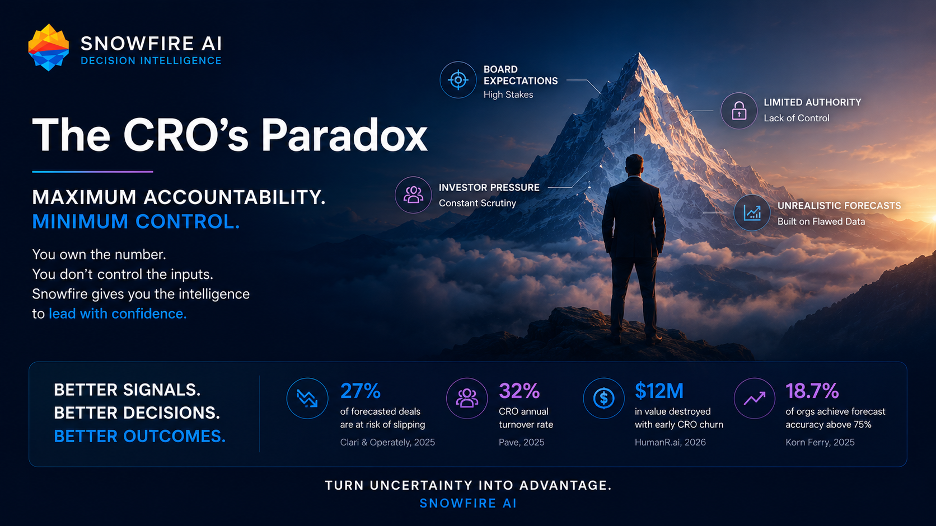
The CRO's Paradox
CROs carry full revenue accountability with fragmented authority, unreliable CRM data, and channel blind spots — why the most scrutinized executive is also the most structurally handicapped.
Read article →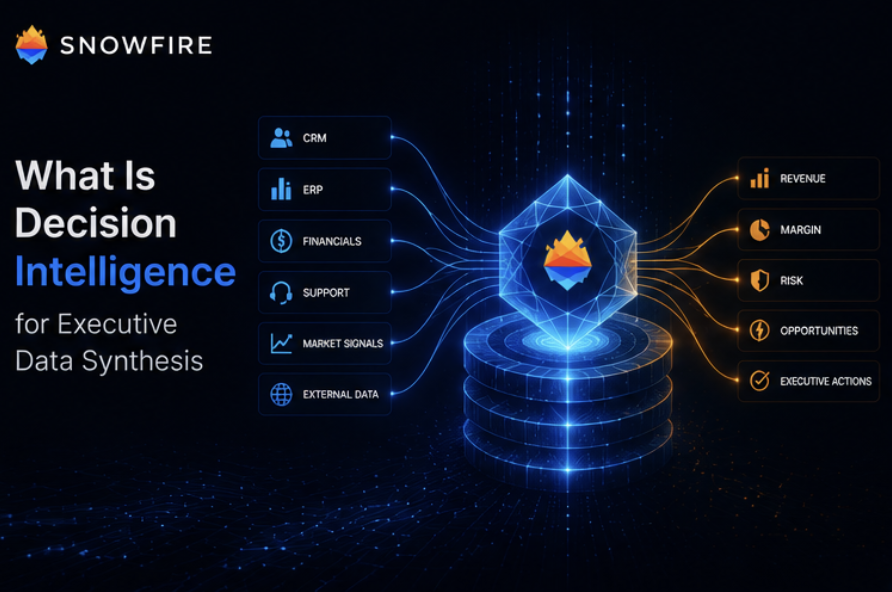
What Is Decision Intelligence for Executive Data Synthesis
Decision intelligence converts organisational data into prioritised, executable recommendations—replacing manual analysis with structured AI reasoning mapped to business outcomes.
Read article →