What Is Decision Intelligence for Executive Data Synthesis
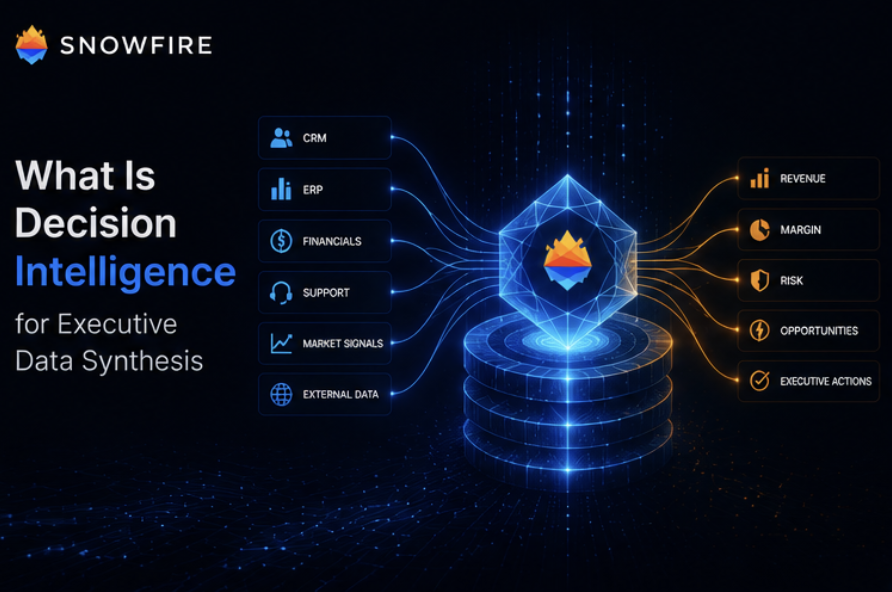
Decision intelligence is the discipline of converting raw organisational data into prioritised, executable recommendations — replacing manual analysis with structured AI reasoning that maps directly to business outcomes.
What does decision intelligence actually mean for executives?
Decision intelligence sits at the intersection of data science, applied AI, and management science. It does not produce charts for analysts to interpret. It produces ranked recommendations for executives to act on. Traditional business intelligence answers the question: what happened? Decision intelligence answers: what should we do next, and why? According to Gartner's 2024 Emerging Tech Impact Radar, more than 65% of organisations that deployed decision intelligence capabilities reported measurably faster executive decision cycles compared with BI-only environments. The shift is structural, not cosmetic.
How is decision intelligence different from traditional business intelligence?
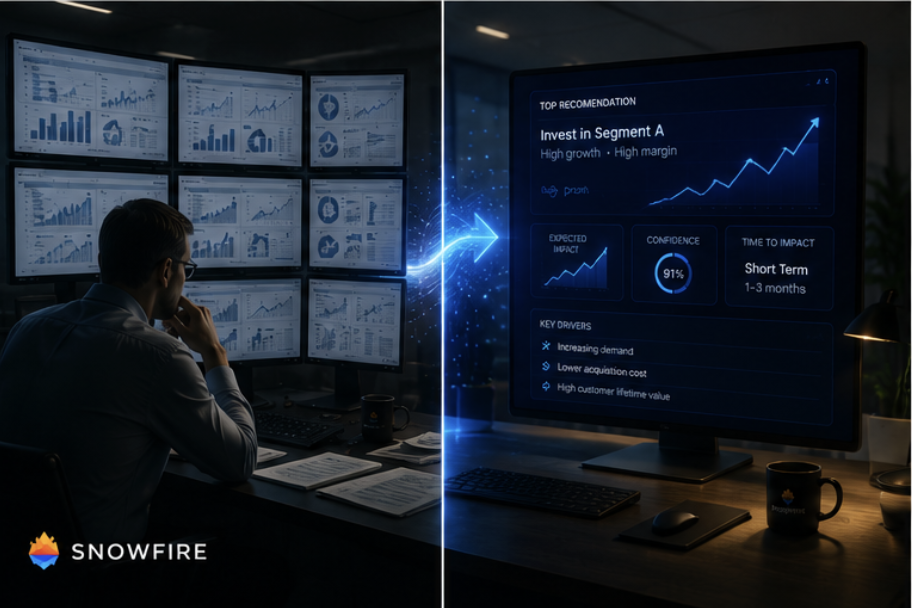
Business intelligence organises historical data into visualisations. Decision intelligence ingests those same data streams — plus unstructured signals, external feeds, and operational context — and outputs a prioritised action sequence with confidence scores attached. The distinction matters because executive time is the binding constraint. A CFO reviewing a revenue variance dashboard still has to perform the synthesis step manually: cross-referencing pipeline data, cost structures, and market signals before reaching a conclusion. Decision intelligence performs that synthesis automatically and presents the conclusion first, with the supporting evidence behind it.
| Dimension | Traditional BI | Decision Intelligence |
|---|---|---|
| Primary output | Dashboard / report | Ranked recommendation |
| User action required | High — interpret and synthesise | Low — review and approve |
| Data types handled | Structured, historical | Structured + unstructured, real-time |
| Latency to action | Days to weeks | Hours to minutes |
| Board-readiness | Requires manual packaging | Native executive narrative |
Why is executive data synthesis a distinct capability?
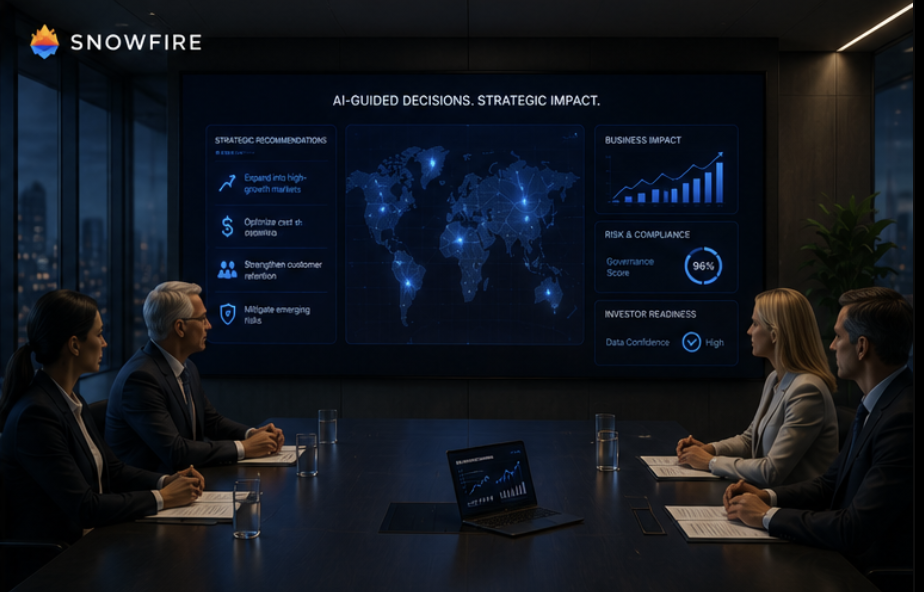
Executive data synthesis is the specific application of decision intelligence at the C-suite layer. It is not a general analytics function. It requires context awareness about organisational priorities, tolerance for uncertainty, and the ability to surface only the decisions that require executive attention — filtering out the rest. A CRO managing a 400-ticket support backlog does not need visibility into every ticket. They need to know which bottlenecks are compressing pipeline conversion, ranked by revenue impact. Executive data synthesis delivers that specificity. General BI platforms do not. McKinsey's 2024 State of AI Report found that organisations with mature AI-assisted decision workflows reduced senior leadership time spent on data review by 37% on average, redirecting that capacity toward strategic and external-facing work.
How does AI decision making work inside a decision intelligence platform?
A decision intelligence platform operates in three sequential layers.
Layer 1 — Ingestion and normalisation.
The platform connects to existing data sources: CRM, ERP, financial systems, support queues, and external market feeds. Data is normalised into a unified semantic layer without requiring migration or replication to a third-party cloud environment.
Layer 2 — Reasoning and synthesis.
AI models apply causal reasoning, not just correlation. They identify which variables are driving an outcome, assign confidence weights, and generate a ranked recommendation set. The reasoning chain is retained and auditable — a requirement in regulated industries where decision audit trails are non-negotiable.
Layer 3 — Executive presentation.
Recommendations surface in natural language with supporting evidence, flagged assumptions, and a proposed action. The executive reviews, adjusts, or approves. The system learns from each interaction and recalibrates future recommendations accordingly. Snowfire AI delivers actions, not dashboards — live in 30 days, connecting to existing data infrastructure without requiring data migration or re-platforming.
What are the board-level risks of not adopting decision intelligence?
The board-level risk is not theoretical. PwC's 2025 Global CEO Survey reported that 72% of CEOs identified slow internal decision cycles as a top-three competitive vulnerability, and 58% said their current data infrastructure was not capable of supporting the AI-assisted decision workflows their boards expected within 24 months. For a CEO or CFO preparing for a board AI readiness review, that gap is a governance exposure. Boards are asking specific questions: What is your AI strategy? How are you reducing dependency on manual synthesis? What is the cost per insight delivered? Enterprise-scale AI infrastructure from vendors such as Palantir carries significant total cost of ownership — licensing, implementation, and the specialist teams required to operationalise it. For mid-market and growth-stage organisations, that cost structure is prohibitive. The relevant question is not whether to adopt decision intelligence, but which deployment model fits the organisation's scale and compliance posture.
How does decision intelligence support investor reporting and fundraising readiness?
Founders and growth-stage leadership teams face a specific synthesis challenge: translating operational data into the narrative investors require. Pipeline velocity, burn efficiency, cohort retention, and unit economics must be presented as a coherent story, not a spreadsheet export. Decision intelligence platforms can automate that translation layer — pulling live data from operational systems and generating investor-ready summaries that are current, consistent, and defensible. EY's 2024 Global Startup Outlook noted that 61% of Series B and later investors now expect AI-assisted reporting as a signal of operational maturity in the companies they evaluate.
What data sovereignty and compliance requirements apply to decision intelligence platforms?
In financial services, healthcare, and any regulated sector, data sovereignty is not a preference — it is a legal obligation. Data processed by a decision intelligence platform may include commercially sensitive forecasts, customer records, or information subject to GDPR, FCA, or sector-specific regulatory frameworks. Platforms that route data through shared cloud infrastructure or US-based LLM APIs introduce jurisdictional risk that compliance and legal teams cannot accept. Snowfire AI operates on the principle that your data never leaves your environment — processing occurs within the organisation's own infrastructure boundary, satisfying both data residency requirements and internal security policy. Capgemini's 2024 AI in Financial Services Report found that 68% of financial services compliance officers cited data residency as the primary barrier to deploying external AI tools at the enterprise level.
Frequently Asked Questions
What is decision intelligence in simple terms?
Decision intelligence is an AI discipline that converts organisational data into specific, ranked recommendations for action. It removes the manual synthesis step that typically sits between data analysis and executive decision-making. The output is a conclusion, not a chart.
How is decision intelligence different from business intelligence?
Business intelligence presents historical data in visual formats for human interpretation. Decision intelligence ingests data and produces prioritised recommendations with supporting rationale already attached. The key difference is that BI requires the executive to synthesise; decision intelligence does the synthesis first.
What decision intelligence tools are available for mid-market companies that cannot afford Palantir?
Enterprise AI platforms like Palantir carry substantial licensing and implementation costs that are typically sized for large-enterprise budgets. Snowfire AI is designed for organisations that need the same decision intelligence capability — same edge, minus a zero — without the infrastructure overhead or specialist team dependency.
How does decision intelligence help a CRO with pipeline visibility?
A decision intelligence platform ingests CRM data, support ticket queues, and revenue operations data simultaneously, then surfaces which bottlenecks are most directly compressing pipeline conversion. The CRO receives a ranked action list rather than a raw pipeline report requiring manual interpretation.
Can decision intelligence platforms meet financial services compliance requirements?
Yes, provided the platform is designed for data residency compliance. Platforms that process data within the organisation's own environment — rather than routing it to external cloud APIs — satisfy GDPR, FCA, and equivalent regulatory frameworks. Audit trail retention is also a standard requirement in regulated deployments.
How quickly can a decision intelligence platform be deployed?
Deployment timelines vary by platform and data infrastructure complexity. Platforms that connect to existing data sources without requiring migration or re-platforming can reach operational status significantly faster than full re-platforming projects. A 30-day live timeline is achievable for organisations with accessible data infrastructure and clear use-case prioritisation.
Is decision intelligence suitable for early-stage companies preparing for fundraising?
Yes. Decision intelligence is particularly valuable for founders who need to translate operational data into consistent, investor-ready narratives. Automating the synthesis layer between live operational data and board or investor reporting reduces manual preparation time and improves the accuracy and currency of the figures presented.
Sources
Related articles
Where Is AI Actually Worth the Investment?
See where AI could create value in your business. Snowfire Transform builds a personalized assessment, estimated ROI, and 90-day roadmap in about 30 seconds.
Read article →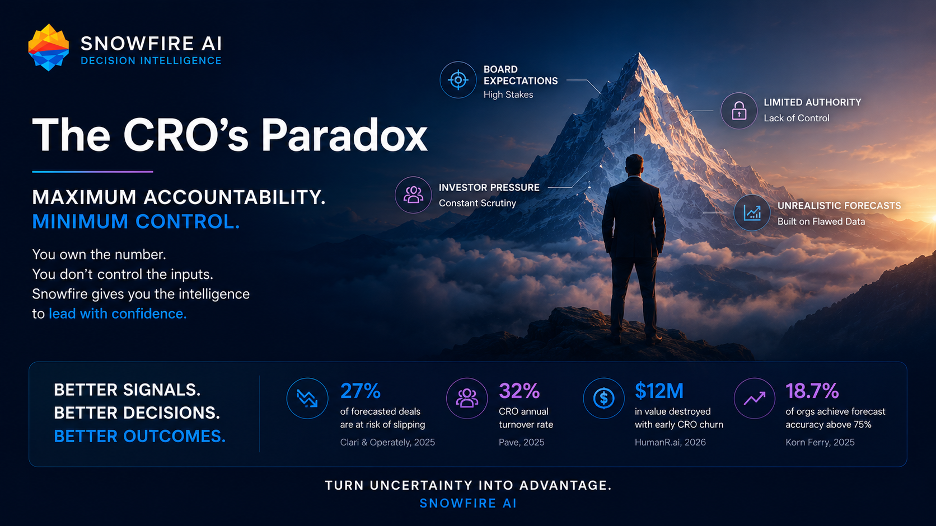
The CRO's Paradox
CROs carry full revenue accountability with fragmented authority, unreliable CRM data, and channel blind spots — why the most scrutinized executive is also the most structurally handicapped.
Read article →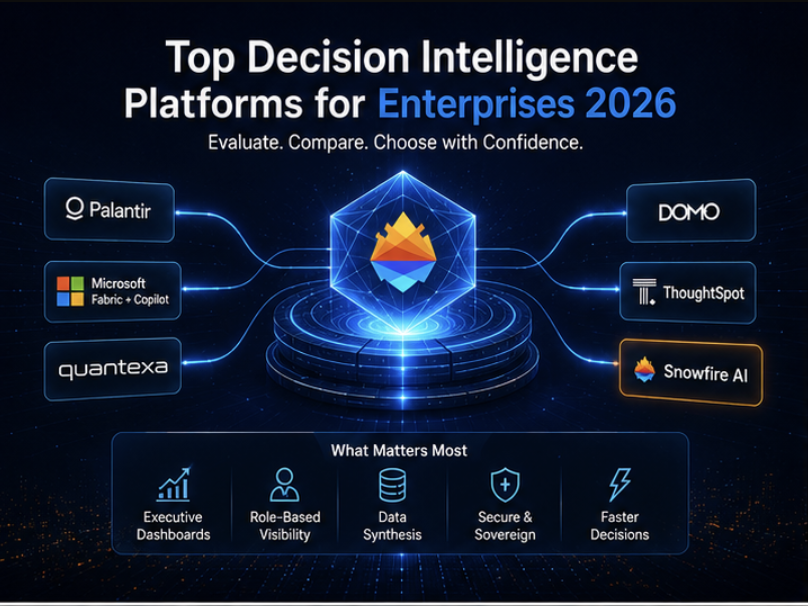
Top Decision Intelligence Platforms for Enterprises 2026
Decision intelligence platforms combine internal operational data with external market signals to generate ranked, role-specific recommendations that replace manual executive reporting cycles.
Read article →