The CRO's Paradox
Maximum Accountability, Minimum Control
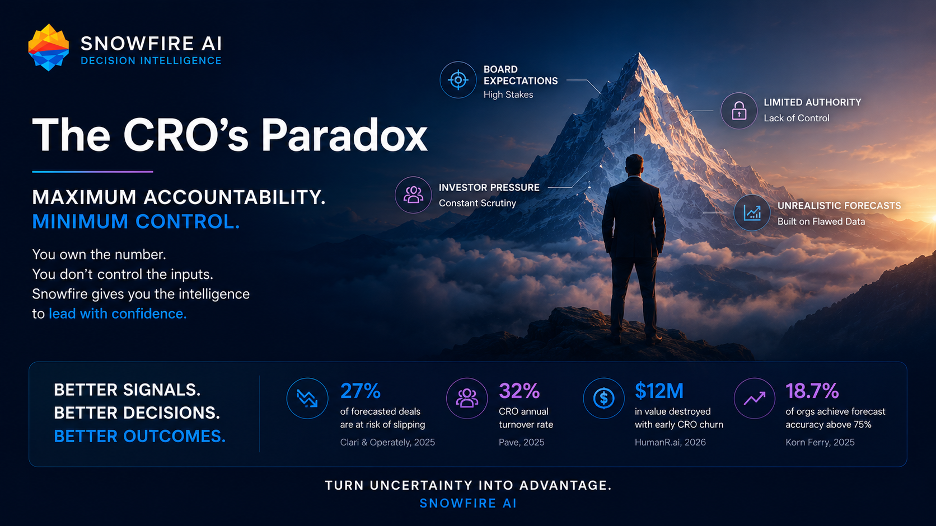
The CRO is the most publicly accountable executive in the building — and often the least structurally equipped to control the number they own. Revenue misses land clean and unambiguous; authority over pipeline, pricing, and partner motion rarely matches that accountability.
The number posts before the meeting ends. Every board member, every investor, every VP in the building already knows whether Q3 landed — and they knew it before you finished your opening slide. No other executive carries this kind of public exposure. The CFO's miss gets explained by macro conditions. The CMO's miss gets buried in attribution models. The CRO's miss just... lands. Clean. Unambiguous. Yours.
And the cruel irony is that the CRO controls less of that number than almost anyone assumes.
Why Does the Person Accountable for Everything Control Almost Nothing?
The accountability is absolute. The authority is not.
Half of all CROs — 50% — cite role ambiguity as their primary frustration: they own the revenue target but lack structural authority over marketing pipeline, customer success expansion, or pricing strategy. (Revenue Operations Alliance, 2025)
They inherit a number that was negotiated before they arrived, built on assumptions they didn't set, fed by systems they don't own, and measured against a quota that often has no relationship to market reality.
This isn't a leadership problem. It's an architecture problem. The CRO role was designed to carry accountability that should be distributed — and then handed a forecast model that would embarrass a first-year analyst.
The most accountable person in the building is also the most structurally exposed.
Snowfire was built for exactly this gap — delivering the intelligence CROs need to run the revenue motion, without requiring the authority they've never structurally had.
Why Do Smart CROs Keep Getting Replaced — Even When They're Doing Everything Right?
The average CRO lasts 21.6 months. That's not a talent problem — that's a structural one.
Pave's 2025 analysis of 14,000 executives found CRO annual turnover at 32% — the highest of any C-suite function, by a wide margin. CMOs survive 43 months. CFOs last 46. CEOs average seven years. The CRO is gone before the second sales cycle completes in most enterprise businesses — before the GTM changes they made have had any real chance to compound.
What makes this worse is what happens after. When a company replaces a CRO before the 24-month mark, the average enterprise loses $12 million in value at a $50 million company. And when boards reach outside for the replacement — which they often do — those external hires produce 7.1 percentage points worse revenue growth than internal promotions. (HBR / SBI Growth, October 2024) The fix makes the problem bigger. 62% of companies see revenue decline or flatline in the year following a CRO departure. (HBR / SBI Growth, October 2024)
The board fires the CRO for missing the number. The miss gets worse after.
The CROs who last longest are not the ones with the best playbook. They are the ones with the best signal.
Why Does Your Q3 Pipeline Look Fine Until It Suddenly Doesn't?
Because 27% of your forecasted deals are going to slip — and you won't know which ones until it's too late to do anything about it.
Deal slip rates have doubled in three years. Gong's analysis of 7.1 million opportunities found quota attainment dropped from 52% to 46% year-over-year. In Q3 2025 specifically, only 43.2% of SaaS reps hit quota — across 249 companies and 49,000+ reps tracked by RepVue. The math on your Q3 call isn't soft. It's structurally broken.
Part of this is deal complexity: the average enterprise B2B deal now involves 13 decision-makers. (Forrester, 2024) Part of it is quota disconnect: 39% of companies raised quotas in 2024 while attainment simultaneously fell. But the larger issue is forecast architecture — most CROs are committing to a number built on a CRM where a meaningful share of deals stopped getting updated months ago.
You're not flying blind. You're flying with instruments you know are wrong, and pretending otherwise until the QBR.
This is the exact gap Snowfire surfaces — which deals are actually moving and which aren't, before the quarter already knows the answer.
What Are Your Sellers Not Telling You — And Why Are They Doing It?
They're not updating the CRM because the CRM doesn't help them sell. It helps you report.
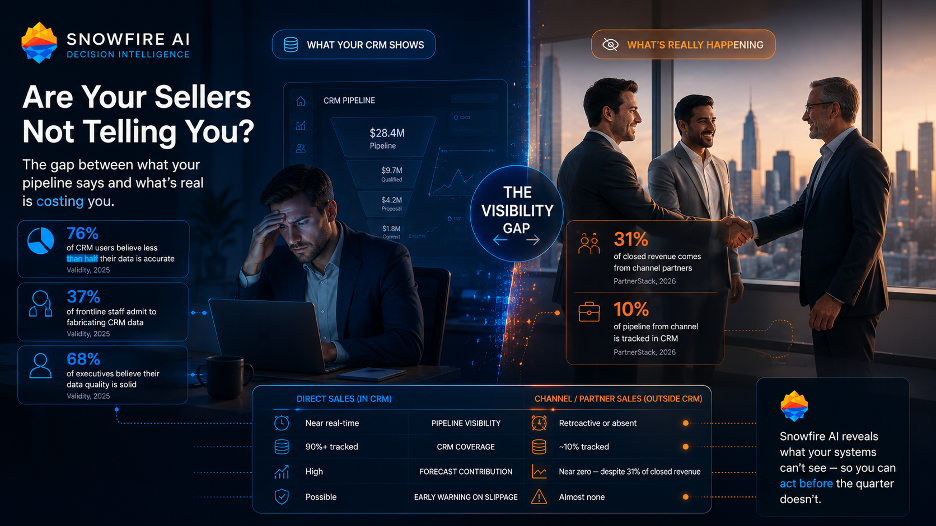
Validity's 2025 survey of 602 sales professionals found that 76% of CRM users believe less than half their data is accurate. More pointed: 37% of frontline staff admit their CRM data cannot be trusted to reflect what is actually happening in their deals. Not rounding. Not estimating. And yet 68% of executives believe their data quality is solid — a belief that sits in direct contradiction to what the people actually entering the data are saying.
This is a rational behavior problem, not a discipline problem. Sellers are paid to close deals. Every minute spent on CRM hygiene is a minute not spent selling. The incentive to tell the truth inside a system that doesn't reward truth is close to zero.
The gap between what your pipeline says and what your pipeline actually is — that gap lives in the space between the CRM and reality, not on anyone's dashboard.
Why Is Nearly a Third of Your Revenue Invisible Until the Deal Closes?
Because your channel partners are closing deals your forecast never saw coming.
Partners deliver 31% of closed revenue at most companies. They represent only 10% of the tracked pipeline. (PartnerStack, 2026) That's not a small discrepancy — that's a structural forecasting hole large enough to explain most Q3 misses on its own. The channel isn't a supplemental revenue source. It just doesn't show up in your CRM until the deal is already closed — at which point it's a pleasant surprise, not a planned outcome.
| Signal | Direct sales | Channel / VAR |
|---|---|---|
| Pipeline visibility | Near real-time | Retroactive or absent |
| CRM coverage | 90%+ tracked | ~10% tracked |
| Forecast contribution | High | Near zero — despite 31% of closed revenue |
| Early warning on slippage | Possible | Almost none |
Snowfire closes that blind spot directly — surfacing partner-sourced pipeline in real time so the CRO is forecasting from the full picture, not half of it.
What Does a CRO Who Actually Hits Q3 Do Differently?
They stop waiting for the forecast to tell them what already happened. They build visibility into where the pipeline actually lives and where it's turning.
The CROs who consistently hit their number aren't better forecasters — they operate with better visibility into where the "dark" pipeline lives. They know which sellers are sandbagging versus genuinely stuck. They have a system that surfaces the intelligence before it shows up as a missed quarter on a board slide.
Case in point: a $4B global VAR and cybersecurity solutions provider hit exactly this problem at scale — 200+ sellers, partner-led revenue that wasn't showing up in the pipeline until deals closed, and no unified signal on where the next dollar was coming from.
In 12 weeks, after deploying Snowfire AI, an AI-driven revenue intelligence platform:
- $1.1M in net-new pipeline per rep per week — auto-delivered
- $1B+ in pipeline contextualized and made actionable
- +3% gross margin lift
- Deployed inside Microsoft Teams — zero adoption friction
- Selected over Microsoft Copilot and Google Agentspace
The difference wasn't headcount or a better CRM rollout. It was intelligence that met sellers where they worked — and surfaced the right signal before the quarter was over.

This Is Not Five Separate Problems. It Is One.
The accountability gap. The tenure clock. The pipeline that looks fine until it doesn't. The CRM that isn't telling the truth. The partner revenue that never shows up until the deal is closed.
These are not five independent failures. They are five symptoms of the same root cause: revenue leaders don't have the intelligence they need to run the revenue motion they're accountable for.
Every missed quarter, every early replacement, every QBR that starts with 45 minutes of context-gathering and five minutes of actual decisions — all of it traces back to the same gap between what the data contains and what actually reaches the CRO in time to act on it. Snowfire was built to close exactly that gap. Explore CRO pipeline intelligence to see how it works inside Microsoft Teams.
Frequently Asked Questions
Why do CROs keep getting fired even when they're talented?
Because the role is structurally broken. The CRO carries full accountability for revenue but rarely has structural authority over marketing pipeline, CS expansion, or pricing. When the number misses, the CRO is the visible owner — regardless of whether the miss was caused by factors outside their control. At 21.6 months average tenure, most CROs don't survive long enough for their strategic changes to compound.
How do I know if my Q3 forecast is actually accurate?
Statistically, it probably isn't. Only 43.2% of SaaS reps hit quota in Q3 2025, and deal slip rates have doubled in three years. The leading indicators to watch: deal slip rate, days since last meaningful CRM activity per deal, and the ratio of pipeline that is partner-sourced versus directly tracked. If you can't answer that last one, you have a blind spot.
Why are my sellers not updating the CRM?
Because it doesn't help them sell — it helps you report. 37% of frontline staff admit their CRM data cannot be trusted to reflect what is actually happening in their deals. (Validity, 2025) This is a system design problem, not a performance management one. The incentive to maintain accurate data doesn't exist at the rep level in most sales orgs.
How much of my pipeline am I not seeing?
If you have a channel or partner motion — potentially a significant amount. Partners typically represent only 10% of tracked pipeline while delivering 31% of closed revenue. (PartnerStack, 2026) That's not a rounding error — that's a structural forecasting gap.
What is the VAR pipeline blind spot?
VAR and channel partner revenue is almost always tracked retroactively — after the deal closes, not during the sales motion. Most CRMs don't capture partner activity in real time. The result is a structural lag: you know what your VARs closed last quarter, but you have almost no early signal on what they're working this quarter.
What did the $4B VAR do differently to hit $1.1M per rep per week?
They stopped relying on sellers to manually surface intelligence and built a system that did it automatically, deployed in 12 weeks inside Microsoft Teams. Intelligence came to the rep, not the other way around. Net-new pipeline was auto-identified, contextualized, and pushed to the relevant seller — same reps, dramatically better signal.
Sources
- Pave — Executive Compensation Report (2025)
- HBR / SBI Growth Advisory — The High Costs of Chief Revenue Officer Turnover (October 2024)
- HumanR.ai — CRO Retention Benchmarks: 24-Month Tenure Rates (2026)
- Revenue Operations Alliance — 3 Challenges CROs Face in 2025
- RepVue — Q3 2025 Cloud Sales Index
- Gong — The State of Revenue 2025
- SalesSo / QuotaPath — Quota Attainment Statistics (2025)
- Forrester — The State of Business Buying (2024)
- Clari — Deal Slippage: Everything You Need to Know
- Validity — The State of CRM Data Management in 2025
- PartnerStack — The State of Partnerships in GTM (2026)
Related articles

How Adaptive Decision Intelligence Turns Signals Into Actions
Adaptive decision intelligence monitors internal and external signals continuously and pushes role-specific recommended actions—without manual dashboard review.
Read article →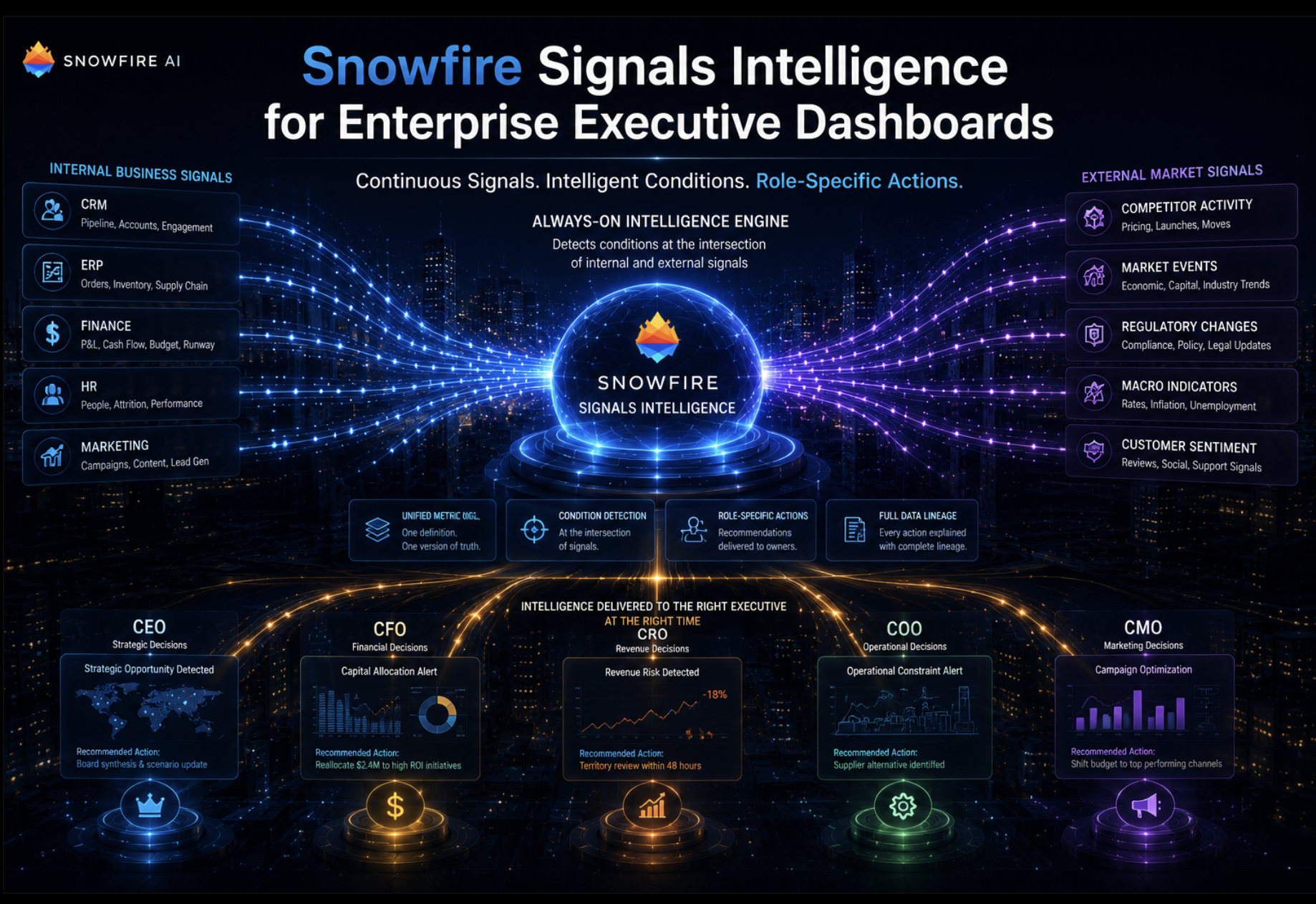
Snowfire Signals Intelligence for Enterprise Executive Dashboards
Always-on Signals Intelligence fuses internal metrics with external market signals and delivers recommended actions to executive dashboards across your stack.
Read article →