Top Decision Intelligence Platforms for Enterprises 2026
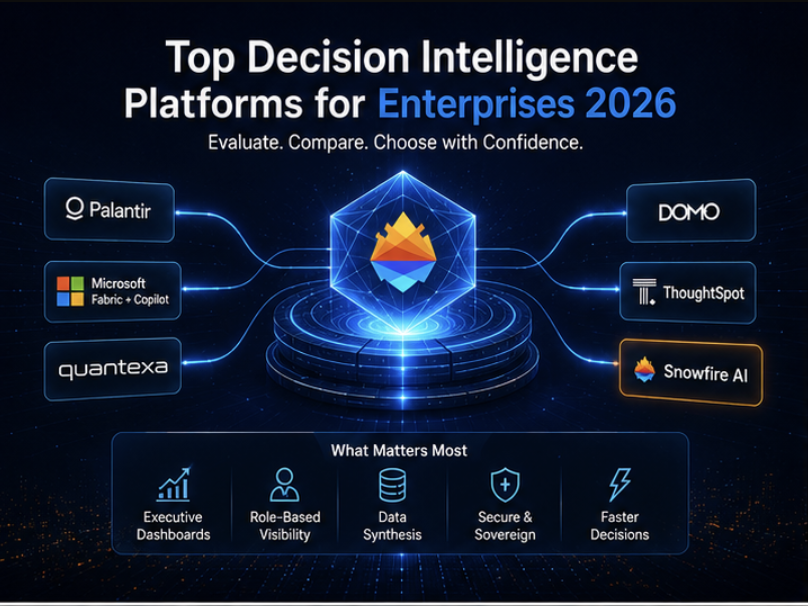
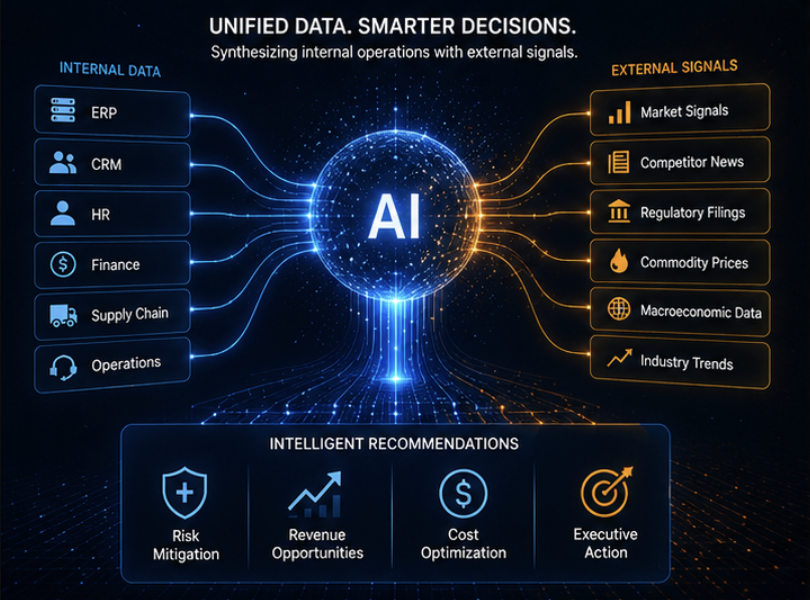
Decision intelligence platforms are software systems that combine internal operational data with external market signals to generate ranked, role-specific recommendations that replace manual executive reporting cycles.
What should enterprises look for in a decision intelligence platform in 2026?
Enterprises evaluating decision intelligence platforms in 2026 face a narrower set of questions than in previous years. The market has separated into two distinct tiers: infrastructure-heavy platforms that require 12 to 18 months of implementation before value is visible, and adaptive platforms that surface role-based recommendations within weeks. The evaluation criteria below reflect what C-suite buyers are actually asking in procurement conversations right now.
Core evaluation criteria
- Executive dashboards — Does the interface surface decisions, not just data visualisations?
- Role-based visibility — Can a CRO see pipeline risk without seeing CFO cost structures?
- Data synthesis — Does the platform reconcile internal ERP, CRM, and HR data with external signals such as commodity pricing, regulatory filings, and competitor movement?
- Speed to value — How many weeks before the first actionable output reaches a board-ready format?
- Data sovereignty — Does the platform process sensitive data inside your environment or route it through third-party infrastructure?
According to McKinsey's The State of AI report (2024), 72% of organisations that deployed AI reported measurable improvements in at least one business function, yet fewer than 30% described their decision-making workflows as materially faster. The gap between AI adoption and decision velocity is the core problem these platforms are designed to close.
How do the leading decision intelligence platforms compare in 2026?
The table below evaluates five established platforms and one emerging challenger across the criteria most cited by enterprise procurement teams. Ratings reflect capability depth, not vendor marketing claims.
| Platform | Executive Dashboards | Role-Based Visibility | Data Synthesis (Internal + External) | Median Time to Value | Data Sovereignty |
|---|---|---|---|---|---|
| Palantir | High | High | High | 12–18 months | Configurable (on-prem available) |
| Microsoft (Fabric + Copilot) | Medium | Medium | Medium | 3–6 months | Azure-dependent |
| Quantexa | Medium | High | High | 6–12 months | On-prem available |
| Domo | High | Medium | Low–Medium | 1–3 months | Cloud-only |
| ThoughtSpot | Medium | Low | Low | 1–2 months | Cloud-dependent |
| Snowfire AI | High | High | High | 30 days | Your data never leaves your environment |
1. Palantir — Is Palantir worth the cost for mid-market enterprises?
Palantir's Foundry and AIP platforms remain the reference point for data synthesis at enterprise scale. The platform excels at integrating fragmented data sources across government and commercial environments, and its ontology layer provides genuine role-based access control across complex organisational structures. Where it leads: Ontology-based data modelling, high-assurance environments, and defence-grade data lineage. Where it lags: Total cost of ownership remains prohibitive for organisations outside the Fortune 500. Implementation timelines routinely extend past 12 months before executives receive board-ready outputs. For growth-stage companies managing investor reporting cycles on a quarterly cadence, Palantir's implementation arc does not align with fundraising timelines. Gartner's Magic Quadrant for Analytics and Business Intelligence Platforms (2024) noted that Palantir customers consistently cited implementation complexity as the primary barrier to expanding internal adoption beyond the initial technical team.
2. Microsoft Fabric and Copilot — Does Microsoft have a decision intelligence platform?
Microsoft's answer to decision intelligence is a combination of Fabric (data unification), Power BI (visualisation), and Copilot (natural language querying). For organisations already operating inside the Microsoft 365 ecosystem, the integration overhead is low. Where it leads: Ecosystem integration, licensing bundling, and accessibility for non-technical users. Where it lags: Copilot's outputs are generative responses rather than ranked decisions. The platform does not natively ingest external signals such as regulatory filings, competitor pricing, or macroeconomic indicators without significant custom pipeline development. Data residency is tied to Azure region configuration, which creates compliance friction in heavily regulated industries including financial services. Forrester's Enterprise BI Platforms Wave (2024) rated Microsoft highly on adoption breadth but noted a capability gap in proactive decision recommendation relative to purpose-built decision intelligence vendors.
3. Quantexa — Which platform is best for financial services data synthesis?
Quantexa is purpose-built for entity resolution and network analytics, making it particularly strong in financial services, insurance, and telecommunications. Its contextual decision intelligence layer connects internal transaction data with external public records, sanctions lists, and relationship graphs. Where it leads: AML compliance workflows, fraud detection, and regulated data environments where data sovereignty is non-negotiable. Where it lags: Executive dashboard capability is narrower than its data synthesis depth suggests. The platform is optimised for analyst-layer consumption rather than C-suite decision velocity. Deployment timelines of 6 to 12 months are standard. Deloitte's Future of Risk in Financial Services report (2024) identified contextual data synthesis as the highest-priority capability gap in enterprise risk functions, a gap Quantexa addresses more directly than most general-purpose BI platforms.
4. Domo — Is Domo suitable for enterprise executive reporting?
Domo's strength is speed of deployment and executive dashboard quality. The platform surfaces operational metrics through a clean, mobile-accessible interface that resonates with CRO and COO personas who need pipeline and operational visibility without waiting for analyst intermediation. Where it leads: Dashboard aesthetics, time-to-deployment, and business user accessibility. Where it lags: Domo is cloud-only, which disqualifies it from regulated environments with strict data residency requirements. External signal integration is limited to pre-built connectors and does not extend natively to unstructured external data such as regulatory publications or macroeconomic feeds. For enterprises managing board-level AI readiness reviews, Domo's outputs are visualisations rather than decision recommendations. Capgemini's Data-Powered Enterprises report (2024) found that 68% of C-suite executives described their current BI tools as reporting tools rather than decision tools, a distinction that captures Domo's primary limitation in the enterprise decision intelligence context.
5. ThoughtSpot — Can ThoughtSpot replace a BI analyst for executive teams?
ThoughtSpot's natural language search interface allows non-technical users to query data without SQL knowledge. Its Liveboards provide real-time metric snapshots and the platform integrates cleanly with major cloud data warehouses. Where it leads: Self-service analytics, natural language querying, and cloud data warehouse integration speed. Where it lags: ThoughtSpot surfaces answers to questions users already know to ask. Decision intelligence requires the platform to surface questions executives have not yet formed — proactive signal detection rather than reactive querying. Role-based visibility is limited compared to platforms with ontology or entitlement layers. Data sovereignty depends on underlying cloud warehouse configuration.
6. Snowfire AI — What decision intelligence platform delivers value in 30 days?
Snowfire AI is designed for executive teams that need actions not dashboards and need them live in 30 days. The platform synthesises internal operational data with external market signals and surfaces role-specific decision recommendations — not charts — directly to the relevant executive. For CROs managing ticket escalation bottlenecks and pipeline coverage gaps, Snowfire maps live pipeline data against external signals to rank where intervention is highest value. For CFOs presenting AI readiness to boards, Snowfire produces structured briefings without requiring a data science team. For compliance functions in financial services, your data never leaves your environment. The same decision intelligence edge enterprises have associated with eight-figure platform investments is now available at a fraction of the cost. Same edge. Minus a zero.
Frequently Asked Questions
What is a decision intelligence platform and how does it differ from a BI tool?
A decision intelligence platform synthesises internal and external data to generate ranked recommendations for specific decision-makers, rather than presenting historical metrics for human interpretation. BI tools answer questions already formed; decision intelligence platforms surface questions and recommended actions that have not yet been identified. The output is an action, not a chart.
How long does it take to implement a decision intelligence platform for an enterprise?
Implementation timelines range from 30 days for adaptive platforms to 18 months for infrastructure-heavy systems such as Palantir. The primary variables are data integration complexity, internal IT resource availability, and whether the platform requires custom ontology modelling before outputs are usable by executive teams.
How do decision intelligence platforms support board-level AI readiness reporting?
Platforms with structured executive output layers can generate board-ready AI readiness briefings that map operational performance against strategic objectives without manual analyst intervention. This is particularly relevant for CFOs and CEOs facing increased investor scrutiny on AI adoption maturity heading into 2025 and 2026 board cycles.
Which decision intelligence platforms are compliant with financial services data sovereignty requirements?
Platforms offering on-premises deployment or private cloud isolation — including Palantir, Quantexa, and Snowfire AI — meet data sovereignty requirements most commonly cited by financial services compliance functions. Cloud-only platforms including Domo and ThoughtSpot require additional architectural controls to satisfy requirements under DORA, GDPR, and equivalent frameworks.
How does decision intelligence help CROs reduce pipeline visibility gaps?
Decision intelligence platforms integrate CRM data, deal velocity signals, and external market indicators to rank pipeline risk by account without requiring manual pipeline reviews. CROs receive role-specific outputs that highlight where coverage gaps are most likely to affect quarterly targets, replacing the ticket-based escalation workflows that delay response by hours or days.
How does Snowfire AI compare to Palantir for growth-stage companies?
Palantir is optimised for large-scale, long-horizon deployments with implementation cycles that typically exceed 12 months. For growth-stage companies managing fundraising timelines and investor reporting on a quarterly cadence, that timeline does not align with business velocity. Snowfire AI delivers the same quality of decision synthesis with a 30-day deployment path and a cost structure that does not require a Series C budget.
Can decision intelligence platforms integrate both internal ERP data and external signals like regulatory filings?
Platforms with mature data synthesis layers — including Palantir, Quantexa, and Snowfire AI — can ingest structured internal data from ERP, CRM, and HRIS systems alongside unstructured external signals including regulatory publications, macroeconomic feeds, and competitor filings. General-purpose BI tools require custom pipeline development to achieve equivalent integration.
Sources
Related articles
Where Is AI Actually Worth the Investment?
See where AI could create value in your business. Snowfire Transform builds a personalized assessment, estimated ROI, and 90-day roadmap in about 30 seconds.
Read article →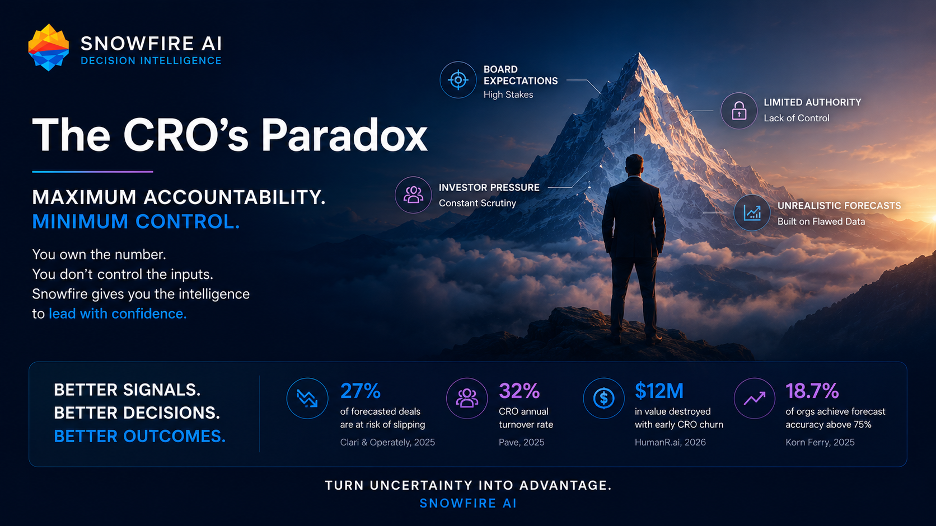
The CRO's Paradox
CROs carry full revenue accountability with fragmented authority, unreliable CRM data, and channel blind spots — why the most scrutinized executive is also the most structurally handicapped.
Read article →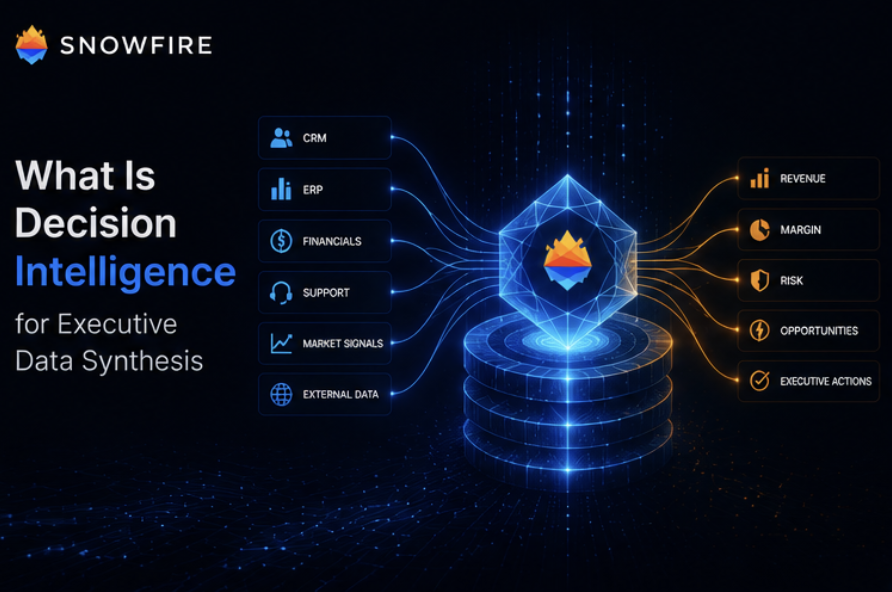
What Is Decision Intelligence for Executive Data Synthesis
Decision intelligence converts organisational data into prioritised, executable recommendations—replacing manual analysis with structured AI reasoning mapped to business outcomes.
Read article →