Top 7 Reasons BI Platforms Fail Enterprises
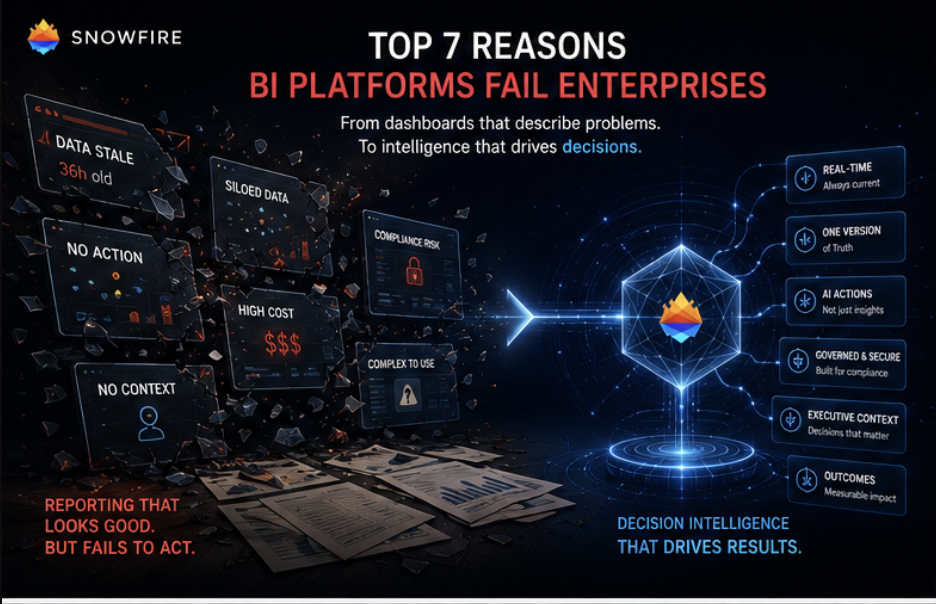
Traditional BI platforms fail enterprises when they deliver historical data visualisations without automated action — creating reporting systems that describe problems after they have already cost the business money.
What does “BI platform failure” actually mean in an enterprise context?
BI failure is not a software crash. It is the gap between what a platform was sold to deliver — faster decisions, clearer insight, measurable ROI — and what it actually produces: more dashboards that require more analysts to interpret them before anything changes. According to Gartner's 2024 Analytics and BI Market Guide, 70% of data and analytics projects fail to deliver their intended business value. That number has not meaningfully improved in three years.
Why do enterprises still invest in BI platforms that do not deliver?
The investment cycle is self-reinforcing. Procurement teams select platforms like Tableau, Power BI, or Domo based on demo performance and analyst rankings, not deployment outcomes. Once licences are signed and infrastructure is built around a platform, switching costs suppress honest evaluation. The result is that enterprises continue renewing tools that their own teams have quietly stopped trusting.
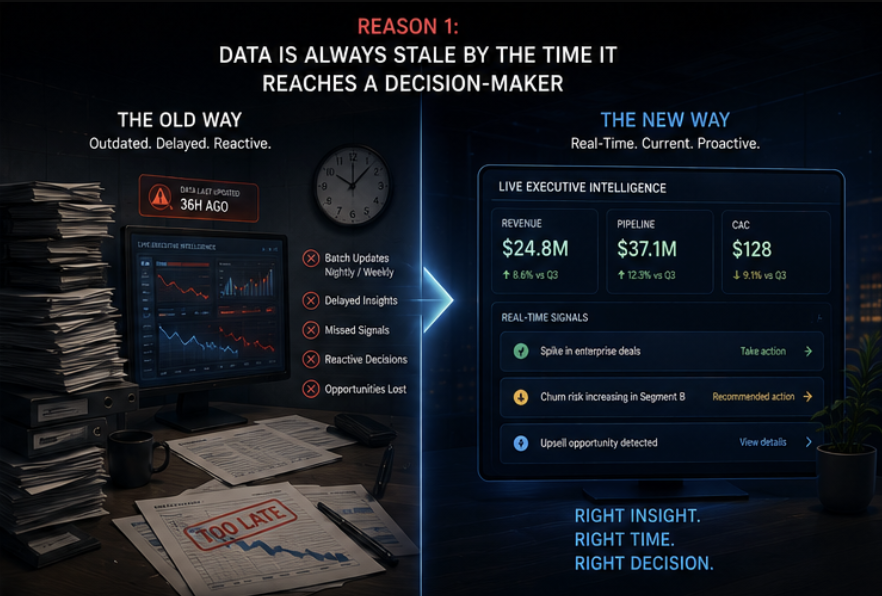
Reason 1: Data is always stale by the time it reaches a decision-maker
Most enterprise BI pipelines operate on batch refresh cycles — hourly, nightly, or weekly. By the time a CEO reviews a revenue dashboard in a board meeting, the underlying data may be 36 hours old. McKinsey's 2024 The State of AI in Business report found that organisations with real-time data pipelines are 2.5x more likely to report above-average profitability than those relying on batch processes. Stale data does not support real-time decisions. It supports post-mortems.
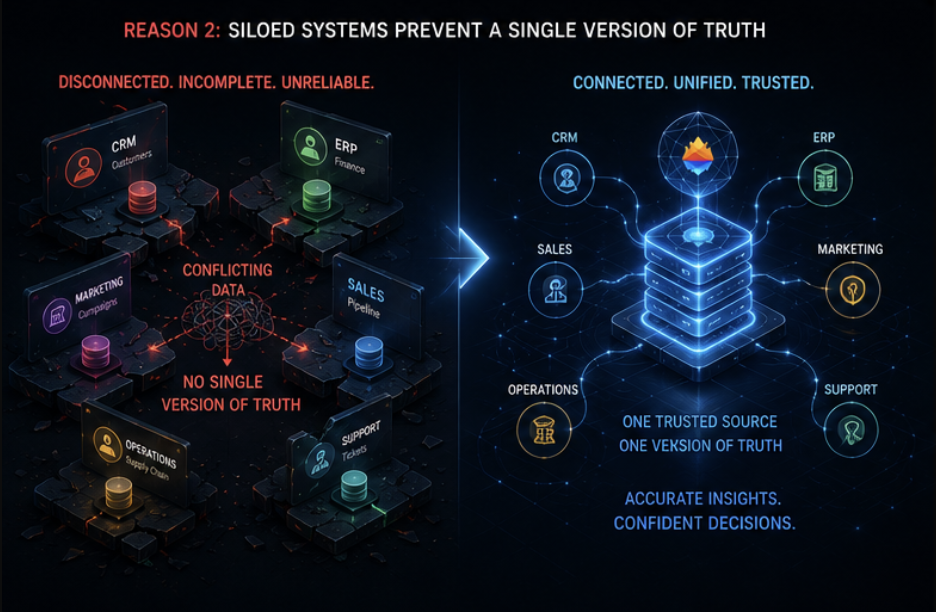
Reason 2: Siloed systems prevent a single version of truth
Enterprises run an average of 976 applications, according to MuleSoft's 2024 Connectivity Benchmark Report. BI platforms installed on top of fragmented data estates do not solve fragmentation — they visualise it. A CRO reviewing pipeline data in Power BI sees CRM numbers. The CFO sees ERP numbers. Neither figure matches because the source systems were never reconciled. The dashboard looks clean. The underlying problem remains invisible.
Reason 3: Platforms require specialist interpretation before anyone can act
A Tableau dashboard built by a data team for an executive audience still requires the executive to form a question, request an analysis, wait for delivery, and then decide. Forrester's 2024 Insights-Driven Business Benchmark found that 58% of business leaders say they cannot access the data they need in time to make relevant decisions. The bottleneck is rarely storage or processing power. It is the human translation layer between data and decision.
Reason 4: BI platforms generate outputs without recommended actions
Tableau shows you that sales conversion dropped 12% in Q3. Power BI shows you that customer acquisition cost increased 18% month-over-month. Domo shows you that churn spiked in a specific segment. None of them tell you what to do about it. Deloitte's 2025 Global AI Adoption Survey found that 62% of executives say their analytics tools surface problems without providing recommended responses. Descriptive intelligence without prescriptive output creates alert fatigue, not action.
Reason 5: Compliance and data governance requirements are treated as afterthoughts
Regulated industries — financial services, insurance, healthcare — operate under data residency and governance frameworks that generic BI platforms were not designed to accommodate. Sending sensitive financial or customer data to cloud-based BI infrastructure can create material compliance exposure under GDPR, DORA, and FCA guidelines. PwC's 2025 Global Risk Survey found that 47% of financial services firms have delayed or cancelled analytics deployments due to unresolved data sovereignty concerns. Platforms that cannot operate within a sovereign data boundary are not enterprise-ready for regulated sectors. Snowfire's architecture is built on a single principle: your data never leaves your environment — making it deployable in regulated industries without compliance renegotiation.
Reason 6: The total cost of ownership is consistently underestimated
A Palantir enterprise deployment can carry a price point starting at £500,000 annually before customisation, professional services, or integration costs. Tableau and Power BI licences appear accessible at the headline level but scale expensively with user seats, premium connectors, and the data engineering resource required to keep pipelines functioning. EY's 2024 Technology Risk and Value Report found that 54% of enterprise technology investments exceed their original budget by more than 40% within the first two years. The BI failure story is often a cost story that the board does not see until renewal.
Reason 7: Executive context is absent from every layer of the platform
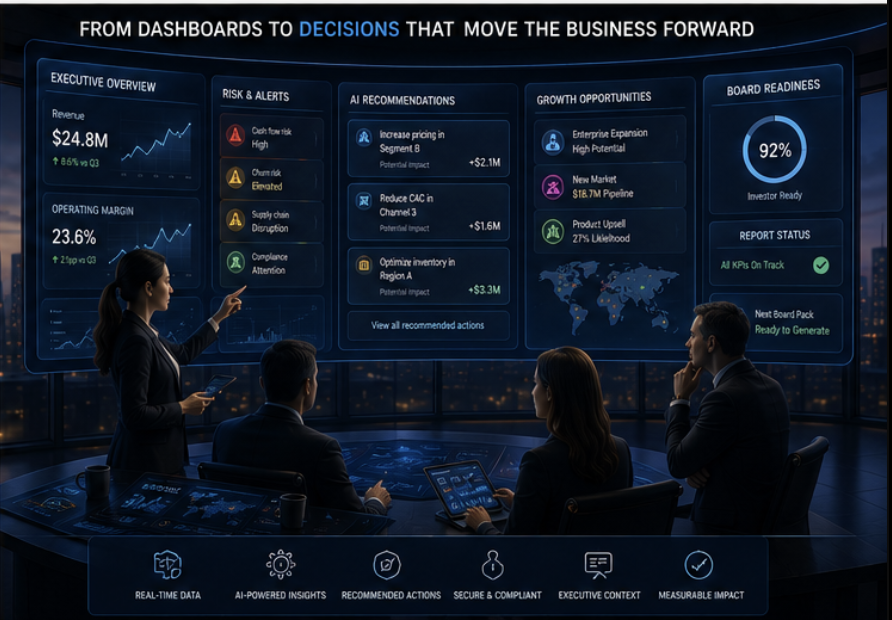
A founder preparing for a Series B is not asking a BI platform for an EBITDA chart. They need investor-ready narrative, forward-looking scenarios, and evidence of operational control. A board asking about AI readiness is not served by a pipeline dashboard — they need a structured view of where intelligence is actually embedded in the business. Capgemini's 2025 Data-Driven Enterprise Report found that 65% of C-suite executives say their BI tools do not produce outputs in a format suitable for board-level reporting. The platform produces data. Executives need decisions. Snowfire delivers actions not dashboards and is live in 30 days — removing the gap between data output and executive decision without requiring a programme team to bridge it.
How do Tableau, Power BI, and Domo compare on enterprise failure points?
| Failure Point | Tableau | Power BI | Domo | What Enterprises Need |
|---|---|---|---|---|
| Real-time data freshness | Batch-dependent | Near real-time with Premium | Near real-time | Continuous, sub-minute refresh |
| Data sovereignty | Cloud-first architecture | Microsoft-controlled cloud | Cloud-hosted | On-premises or private cloud deployment |
| Prescriptive output | Descriptive only | Limited AI suggestions | Descriptive only | Recommended actions with reasoning |
| Executive-ready narrative | Manual build required | Manual build required | Manual build required | Auto-generated board-level context |
| Deployment timeline | 3–9 months typical | 2–6 months typical | 3–6 months typical | Live in 30 days or fewer |
| SME to enterprise cost scaling | High seat-based costs | Lower entry, high scale cost | High at enterprise tier | Predictable cost without seat penalties |
Frequently Asked Questions
Why do BI platforms fail to deliver ROI in enterprise deployments?
BI platforms fail to deliver ROI because they require continuous investment in data engineering, analyst resource, and licence management to produce outputs that still require human interpretation before any action is taken. The value chain from data to decision is too long to produce consistent returns. Gartner's 2024 data shows 70% of analytics projects fail to meet their stated objectives.
How does a CRO solve the pipeline visibility problem that BI platforms create?
CROs face a specific version of BI failure: pipeline data lives in CRM, marketing attribution lives in a separate system, and the BI platform shows a reconciled view that is already 24 hours old. The result is that revenue forecasts are built on incomplete and delayed information. Decision intelligence platforms that ingest live CRM and marketing data and surface recommended actions close this gap without requiring analyst intermediaries.
Why are BI platforms a compliance risk for financial services firms?
Cloud-based BI platforms require data to leave the enterprise environment for processing and rendering, which creates potential conflicts with GDPR, DORA, and FCA data residency obligations. Many financial services firms have discovered this risk only after deployment, triggering costly remediation or tool replacement. PwC's 2025 Global Risk Survey found 47% of FS firms have delayed analytics deployments for this reason.
How can a founder use decision intelligence instead of BI for investor reporting?
Investors in Series A and Series B rounds require forward-looking operational metrics, cohort analysis, and scenario modelling — none of which traditional BI platforms produce automatically. Founders using descriptive dashboards spend significant time manually reformatting data into board-ready narratives. Decision intelligence platforms built for investor reporting generate structured outputs directly from live operational data.
Is Palantir a better alternative to traditional BI platforms for enterprises?
Palantir solves the data integration and AI layer problem at scale, but its deployment model requires embedded engineering teams, multi-year contracts, and starting costs that exclude most mid-market enterprises. It is a credible tool for defence and large government contracts where those conditions exist. For enterprises that need decision intelligence — same edge, minus a zero in cost and time — the value proposition does not hold.
What does a CEO need to demonstrate AI readiness to their board?
A CEO demonstrating AI readiness to a board needs to show where intelligence is embedded in operational processes, what decisions it is influencing, and what governance frameworks are in place. A Tableau dashboard showing AI project spend does not satisfy that requirement. Board-ready AI reporting requires structured evidence of decision automation, compliance controls, and measurable outcome attribution.
Why do BI platforms struggle with siloed enterprise data?
BI platforms visualise data structures — they do not resolve them. When source systems are not integrated at the data layer, a BI platform produces multiple conflicting views of the same business, one per system. The fix requires data engineering investment that sits outside the platform entirely and must be maintained continuously as systems change.
Sources
- Gartner — Analytics and BI Market Guide, 2024
- McKinsey — The State of AI in Business, 2024
- MuleSoft — Connectivity Benchmark Report, 2024
- Forrester — Insights-Driven Business Benchmark, 2024
- Deloitte — Global AI Adoption Survey, 2025
- PwC — Global Risk Survey, 2025
- EY — Technology Risk and Value Report, 2024
- Capgemini — Data-Driven Enterprise Report, 2025
Related articles

Where Is AI Actually Worth the Investment?
See where AI could create value in your business. Snowfire Transform builds a personalized assessment, estimated ROI, and 90-day roadmap in about 30 seconds.
Read article →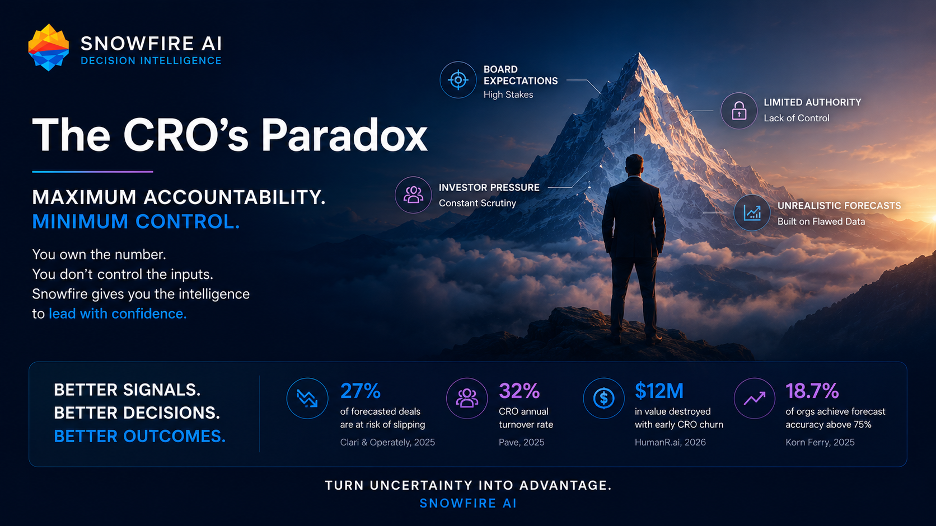
The CRO's Paradox
CROs carry full revenue accountability with fragmented authority, unreliable CRM data, and channel blind spots — why the most scrutinized executive is also the most structurally handicapped.
Read article →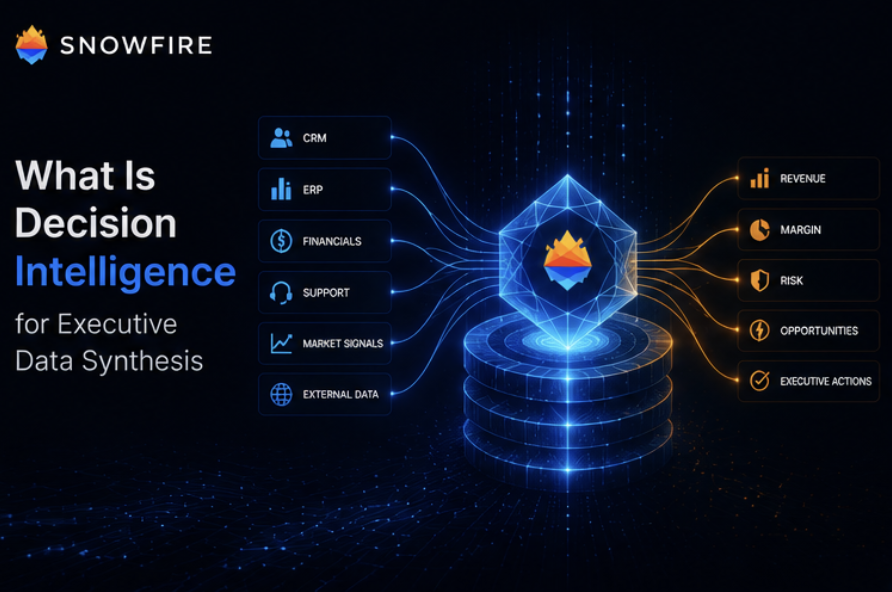
What Is Decision Intelligence for Executive Data Synthesis
Decision intelligence converts organisational data into prioritised, executable recommendations—replacing manual analysis with structured AI reasoning mapped to business outcomes.
Read article →