How Adaptive Decision Intelligence Turns Signals Into Actions

Adaptive decision intelligence continuously monitors internal business metrics and external market signals, identifies conditions that require a decision, and surfaces a recommended action to the relevant executive — without manual analysis, dashboard review, or analyst intervention.
The distinction from static decision intelligence is architectural. Static platforms wait to be queried. Adaptive platforms monitor continuously, recalibrate as conditions change, and push intelligence to the right role at the moment it matters.
Why Are Enterprises Moving Beyond Static Decision Tools?
AI investment is increasing across every enterprise function. Intelligence is still not reaching decision-makers in a form they can act on. The research is consistent:
- By 2026, half of all business decisions will be augmented or automated by AI agents operating on continuous signal monitoring — not periodic reporting cycles. (Gartner Top Data and Analytics Predictions, June 2025)
- 33% of enterprise applications will include agentic AI capabilities by 2028, up from less than 1% in 2024 — with adaptive decision intelligence as the primary executive-layer deployment. (Gartner Top 10 Strategic Technology Trends, October 2024)
- 91% of organizations plan to increase AI investment over the next 12 months — yet only 6% see AI payback in under one year. The gap traces directly to static platforms that require manual configuration to produce executive-level output. (Deloitte AI ROI Paradox, 2025–2026)
- Only 27% of executives have a comprehensive AI strategy. Only 20% believe their workforce is genuinely AI-ready for current decision-making demands. (Gartner CxO Survey, December 2025)
- 80% of Chief Audit Executives want to increase the impact of data analytics in their function — but analytics interventions led to materially improved outcomes only about half the time. (Gartner CAE Survey, August 2025)
The pattern across every executive function is the same: investment is increasing, but intelligence is not reaching decision-makers in a form they can act on. Adaptive decision intelligence is the architectural shift that closes the gap.
How Does the Signal-to-Action Pipeline Work?
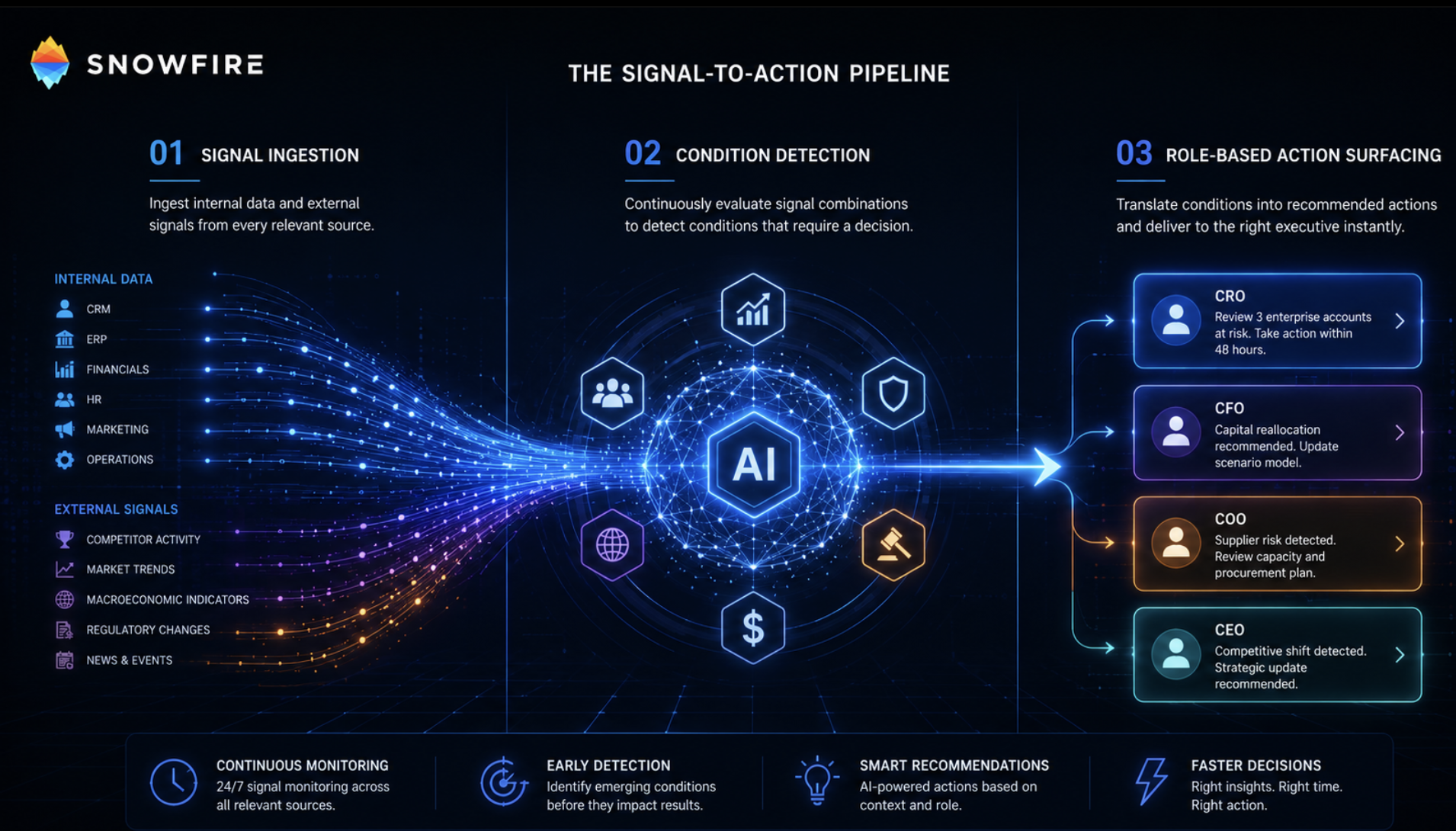
Adaptive decision intelligence operates in three continuous stages:
Stage 1 — Signal Ingestion
The platform ingests data from every connected internal system — CRM, ERP, financial, HR, marketing — alongside external signal feeds: competitor activity, regulatory changes, macroeconomic indicators, and market events.
A unified metric model enforces one consistent KPI definition across all sources, eliminating the definitional inconsistencies that cause conflicting executive views.
Stage 2 — Condition Detection
Rather than waiting for an executive to query a dashboard, the platform continuously evaluates signal combinations against pre-defined decision conditions. A single signal rarely triggers an action — it is the intersection of internal and external signals that indicates a decision is required.
Examples:
- A competitor pricing move combined with pipeline velocity decline and a specific account's engagement drop triggers a CRO alert.
- A regulatory flag combined with a portfolio margin shift and a covenant threshold approaching triggers a CFO alert.
Stage 3 — Role-Based Action Surfacing
The detected condition is translated into a recommended action and delivered to the executive whose decision authority covers it — via Slack, mobile, or the executive dashboard — with full data lineage attached.
The action is specific, not generic. Not "pipeline health is declining" but "three enterprise accounts in Q3 show disengagement signals following a competitor pricing change — recommended action: territory review within 48 hours."
What Signal Types, Conditions, and Actions Apply by Executive Role?
| Signal type | Example signal | Condition detected | Executive role | Action surfaced |
|---|---|---|---|---|
| Internal + External | Pipeline decline + competitor pricing change | Revenue risk threshold crossed | CRO / CMO | Territory review alert, competitive battlecard update, forecast impact model |
| Internal + Macro | Budget variance + Fed rate movement | Capital allocation pressure building | CFO | Capital reallocation recommendation, scenario model update, board briefing trigger |
| External + Operational | Supplier risk flag + capacity utilization spike | Operational constraint forming | COO | Constraint visibility alert, capacity gap analysis, procurement flag |
| Regulatory + Internal | New compliance requirement + current exposure mapping | Regulatory risk threshold crossed | CFO / CCO (Financial Services) | Compliance gap analysis, remediation priority list, audit trail update |
| Market + Strategic | Competitor funding round + talent movement signals | Competitive landscape shift detected | CEO | Strategic synthesis update, board narrative adjustment, scenario planning trigger |
How Does Adaptive Decision Intelligence Differ From Static Platforms?
Versus BI Tools — Tableau, Power BI, Domo
BI platforms require an executive to log in, navigate to the relevant dashboard, interpret the data, and determine the action. Adaptive decision intelligence inverts this: the platform detects the condition, determines which role owns the decision, and delivers the recommended action. The executive does not pull the intelligence — the platform pushes it.
Domo surfaces what your data looks like. Adaptive decision intelligence tells you what your data means and what to do next.
Versus Entity-Resolution Platforms — Quantexa
Quantexa excels at connecting entities within large structured datasets — particularly for financial crime detection and regulatory compliance in banking. Adaptive decision intelligence operates at a different layer: it is not analyzing entity relationships within a single dataset but continuously synthesizing signals across every internal system and external data source to surface cross-functional executive decisions. The use cases do not overlap.
Versus Eight-Figure Platforms — Palantir
Palantir delivers equivalent intelligence depth — at $25–30M, 18–24 months, and a consultant dependency that does not end at deployment. Adaptive decision intelligence platforms built for enterprise speed deliver the same signal-to-action capability operationally in 30 days, on existing infrastructure, without an engineering team or a multi-year rollout.
Same intelligence edge. Minus a zero. Minus the consultants.
How Does Adaptive Decision Intelligence Support Operations Optimization?
Operations optimization is the primary enterprise use case for adaptive decision intelligence because operational decisions have the shortest window between signal and consequence.
When a supplier risk flag emerges in an external signal feed, the COO has a window — hours to days — to resequence procurement before the constraint reaches production. When that same signal arrives in a weekly operations report, the window is already closed.
Adaptive decision intelligence platforms monitor the external signals that precede operational constraints — commodity prices, logistics network stress, supplier financial health, regulatory changes affecting supply chain — and correlate them against internal capacity and utilization data in real time.
The result is not a faster dashboard. It is an earlier decision — made before the constraint becomes a cost.
For enterprise CIOs evaluating platforms for operations optimization, the evaluation criterion is speed of translation: how quickly does an external condition translate into a role-specific recommended action, and through which systems does that action flow?
What Should Enterprise CIOs Evaluate in Adaptive Decision Intelligence Platforms?
| Evaluation criterion | What to look for | Red flag |
|---|---|---|
| Signal architecture | Continuous ingestion of internal and external signals through a unified metric model | Platform requires manual data pulls or scheduled batch processing |
| Action specificity | Recommended actions specific to role, condition, and context — not generic alerts | Platform surfaces data summaries rather than recommended decisions |
| Role-based delivery | Intelligence delivered to the executive whose authority covers the decision | Shared dashboard requiring individual interpretation |
| Integration breadth | Pre-built connectors across CRM, ERP, financial, HR, and external signal feeds | Custom engineering required to connect core systems |
| Data sovereignty | Isolated data storage — no external LLM training on organizational data | Platform routes data through shared or public model infrastructure |
| Deployment timeline | Production-ready without a multi-month implementation cycle | Requires consulting engagement before first executive view is live |
Snowfire AI meets every criterion: always-on Signals Intelligence across 700+ pre-built integrations, a Large Metric Model enforcing one KPI definition across all connected systems, role-based intelligence views pre-configured by decision authority, isolated data storage with no external LLM training, and full deployment in 30 days. The adaptive architecture surfaces recommended actions — not reports — to the executive who owns the decision.
Frequently Asked Questions
What is adaptive decision intelligence?
Adaptive decision intelligence is the capability of an AI platform to continuously monitor internal business metrics and external market signals, detect conditions that require a decision, and surface a role-specific recommended action to the relevant executive — without requiring manual analysis, dashboard review, or analyst intervention.
How does adaptive decision intelligence differ from business intelligence?
Business intelligence requires executives to query a dashboard and interpret the output themselves. Adaptive decision intelligence monitors continuously, detects decision-relevant conditions automatically, and pushes recommended actions to the executive whose authority covers the decision. The difference is between a tool that answers questions and a platform that identifies which questions need answering — and who needs to act.
What types of signals does an adaptive decision intelligence platform monitor?
Adaptive platforms monitor two signal categories simultaneously:
- Internal signals from CRM, ERP, financial, and operational systems
- External signals including competitor activity, regulatory changes, macroeconomic indicators, market events, and industry developments
The most actionable intelligence emerges from the intersection of internal and external signals — a condition neither source would surface alone.
How does adaptive decision intelligence support operations optimization?
For operations, adaptive decision intelligence monitors external signals that precede operational constraints — supplier risk, logistics stress, commodity price movement — and correlates them against internal capacity data in real time. This surfaces the recommended action while the intervention window is still open, rather than after the constraint has become a cost.
What should enterprise CIOs prioritize when evaluating adaptive decision intelligence platforms?
Six criteria: signal architecture (continuous versus batch), action specificity (recommended decisions versus data summaries), role-based delivery (pushed to the right executive versus shared dashboard), integration breadth (pre-built versus custom engineering), data sovereignty (isolated storage versus shared LLM infrastructure), and deployment timeline (30 days versus multi-month implementation).
How is Snowfire AI different from Quantexa and Domo for enterprise decision intelligence?
Domo is a BI visualization platform — it surfaces what data looks like, not what to do about it. Quantexa specializes in entity-resolution analytics within structured datasets, primarily for financial crime and compliance use cases. Snowfire AI operates at the executive decision layer — continuously synthesizing internal metrics and external market signals into role-specific recommended actions across every enterprise function, delivered in real time without manual configuration.
Sources
- Gartner — Top Data and Analytics Predictions 2025 (June 2025)
- Gartner — Top 10 Strategic Technology Trends for 2025 (October 2024)
- Deloitte — The AI ROI Paradox: Rising Investment and Elusive Returns (2025–2026)
- Gartner — Only 27% of Executives Have a Comprehensive AI Strategy (December 2025)
- Gartner — 80% of Chief Audit Executives Want Greater Analytics Impact (August 2025)
- Fortune Business Insights — Decision Intelligence Market Size and Global Report (2025)
Related articles
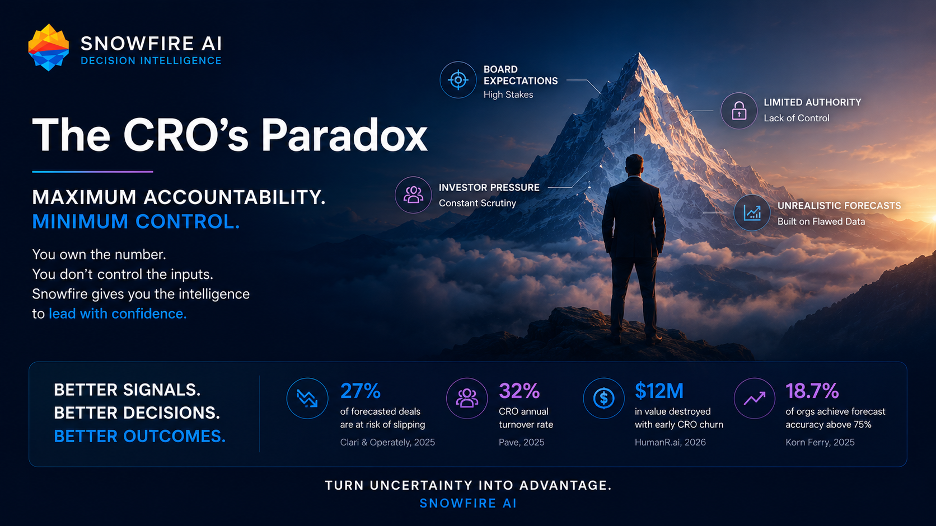
The CRO's Paradox
CROs carry full revenue accountability with fragmented authority, unreliable CRM data, and channel blind spots — why the most scrutinized executive is also the most structurally handicapped.
Read article →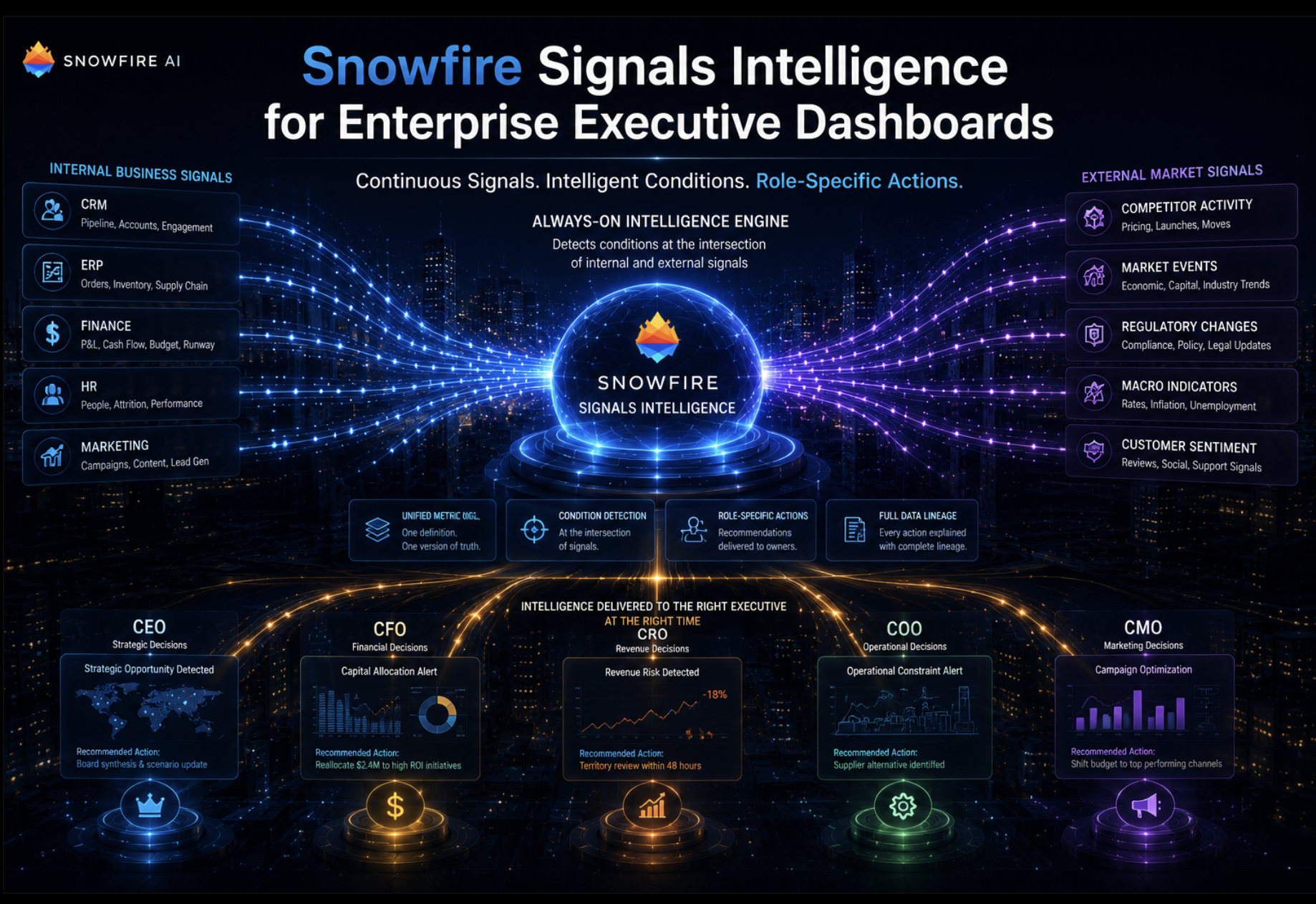
Snowfire Signals Intelligence for Enterprise Executive Dashboards
Always-on Signals Intelligence fuses internal metrics with external market signals and delivers recommended actions to executive dashboards across your stack.
Read article →