Snowfire Signals Intelligence for Enterprise Executive Dashboards
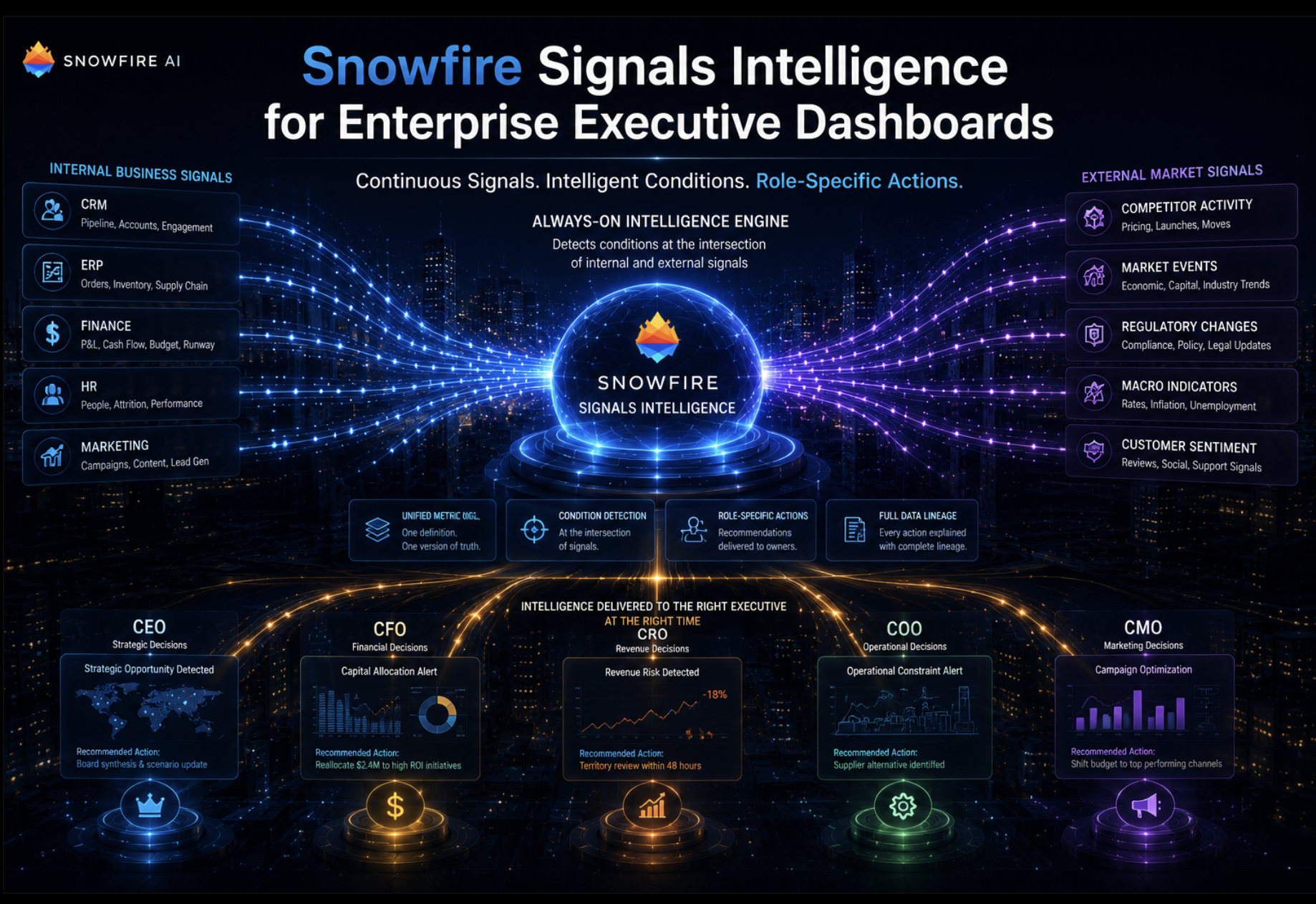
Snowfire Signals Intelligence is the always-on monitoring layer within Snowfire AI that continuously ingests internal business metrics and external market signals, detects conditions requiring executive decisions, and surfaces role-specific recommended actions on enterprise executive dashboards — without manual queries, dashboard review, or analyst intervention.
It is the architectural foundation that separates Snowfire AI from BI tools that wait to be queried and from static platforms that require manual configuration to produce executive-level output.
What Does Snowfire Signals Intelligence Deliver?
Snowfire Signals Intelligence converts enterprise data into role-calibrated intelligence for C-suite leaders:
- Continuous signal monitoring across internal systems (CRM, ERP, finance, HR, marketing) and external feeds (competitor activity, regulatory changes, macroeconomic indicators)
- Condition detection at the intersection of internal and external signals — not single-source alerts
- Role-specific recommended actions pushed to the executive whose decision authority covers the condition
- Full data lineage on every recommended action — which signals triggered it, which systems contributed, which executive received it
- Isolated data storage — organizational data never trains an external model
The platform does not answer "here is your data." It answers "here is what your data means and what you should do next."
Snowfire Signals Intelligence by Executive Function
| Executive function | Signals monitored | Conditions detected | Actions surfaced |
|---|---|---|---|
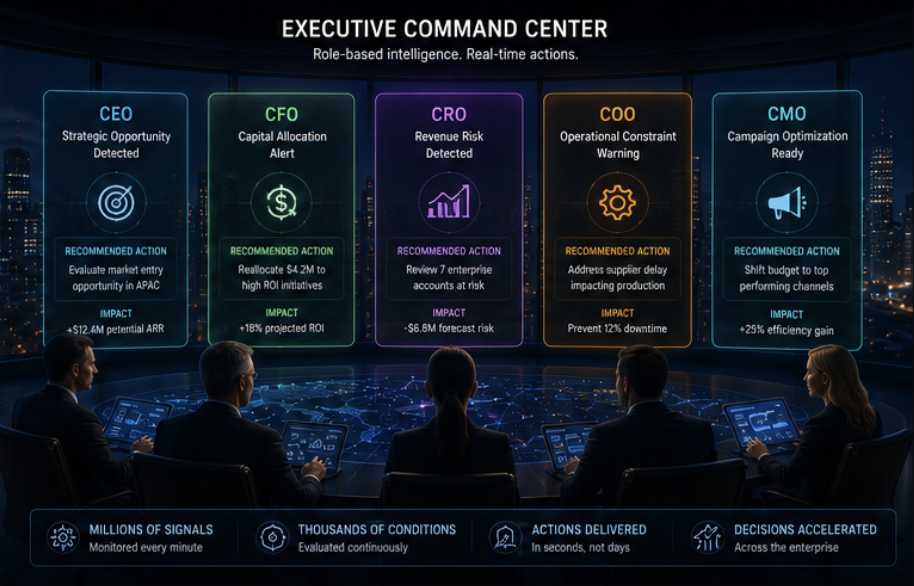
| CEO / President | Cross-functional KPIs, market events, competitive landscape, AI ROI metrics | Strategic inflection points, board narrative gaps, competitive threats | Board-ready synthesis, scenario planning triggers, strategic priority adjustments |
| CFO | Burn/runway, covenant compliance, capital allocation, macroeconomic indicators | Capital pressure, fundraising readiness gaps, budget variance thresholds | Capital reallocation recommendations, investor-grade scenario models, board briefing triggers |
| CRO / VP Sales | Pipeline velocity, deal-level engagement, competitive pricing, forecast accuracy | Revenue risk thresholds, competitive battleground shifts, forecast drift | Territory review alerts, competitive battlecard updates, forecast impact models |
| COO | Capacity utilization, supplier risk, logistics stress, operational KPIs | Operational constraints forming, capacity gaps, procurement flags | Constraint visibility alerts, capacity gap analysis, procurement recommendations |
| CMO | Campaign performance, market sentiment, competitive positioning, pipeline contribution | Marketing efficiency thresholds, competitive messaging shifts | Campaign adjustment recommendations, competitive positioning updates |
| CFO / CCO (Financial Services) | Portfolio margin, regulatory flags, relationship health, compliance exposure | Regulatory risk thresholds, margin compression, relationship deterioration | Compliance gap analysis, remediation priority lists, audit trail updates |
How Does Snowfire Signals Intelligence Differ From BI Dashboards?
BI dashboards require an executive to log in, navigate to the relevant view, interpret the data, and determine the action. Snowfire Signals Intelligence inverts this:
- The platform detects the condition
- Determines which role owns the decision
- Delivers the recommended action proactively
Domo, Tableau, and Power BI surface what your data looks like. Snowfire Signals Intelligence tells you what your data means and what to do next — pushed to the right executive before they have to ask.
What Is the Deployment Model?
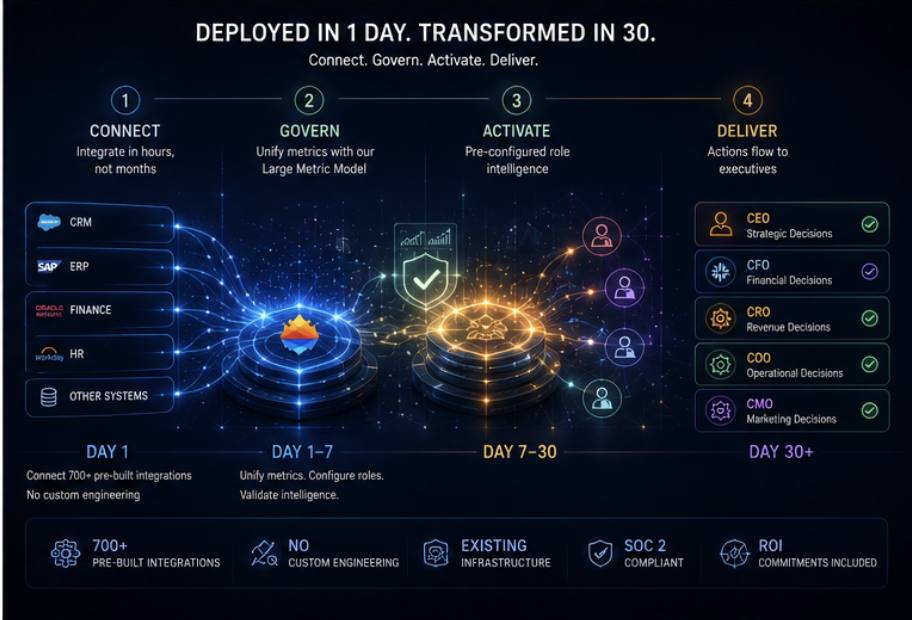
Snowfire AI is production-ready in one business day and fully deployed within 30 days — on existing infrastructure, with no custom engineering required:
- 700+ pre-built integrations across CRM, ERP, financial, HR, and external signal feeds
- Large Metric Model enforcing one consistent KPI definition across all connected systems
- Role-based intelligence views pre-configured by decision authority — not assembled during implementation
- Isolated data storage with SOC 2 compliance and RBAC at source, table, and field level
- ROI commitments included in the SOW
Same intelligence edge as eight-figure platforms. Minus a zero. Minus the consultants. Minus the 18-month rollout.
What Should Enterprise CIOs Evaluate?
| Evaluation criterion | Snowfire AI | Typical BI platform | Typical enterprise AI platform |
|---|---|---|---|
| Signal architecture | Continuous internal + external monitoring | Manual queries, scheduled reports | Batch processing, custom engineering |
| Action specificity | Role-specific recommended actions | Data summaries requiring interpretation | Generic alerts or analyst-mediated output |
| Role-based delivery | Pre-configured by decision authority | Shared dashboard | Requires manual configuration |
| Data sovereignty | Full isolation — no external model training | Cloud-dependent | Shared or public model infrastructure |
| Integration breadth | 700+ pre-built connectors | Native connectors for select systems | Custom engineering for core systems |
| Deployment timeline | 30 days, production-ready day one | 4–8 weeks for dashboard setup | 6–18 months |
Frequently Asked Questions
What is Snowfire Signals Intelligence?
Snowfire Signals Intelligence is the always-on monitoring layer within Snowfire AI that continuously ingests internal business metrics and external market signals, detects conditions requiring executive decisions, and surfaces role-specific recommended actions on enterprise executive dashboards.
How is Snowfire Signals Intelligence different from a BI dashboard?
BI dashboards require executives to query and interpret data themselves. Snowfire Signals Intelligence monitors continuously, detects decision-relevant conditions automatically, and pushes recommended actions to the executive whose authority covers the decision.
What signals does Snowfire Signals Intelligence monitor?
Two categories simultaneously: internal signals from CRM, ERP, financial, and operational systems, and external signals including competitor activity, regulatory changes, macroeconomic indicators, and market events. The most actionable intelligence emerges from the intersection of both.
How quickly can Snowfire Signals Intelligence be deployed?
Production-ready in one business day. Fully deployed within 30 days — on existing infrastructure, with 700+ pre-built integrations and no custom engineering required.
Is organizational data secure with Snowfire Signals Intelligence?
Yes. Snowfire AI operates on isolated, organization-specific data storage. Organizational data never trains an external model. The platform is SOC 2 compliant with RBAC at source, table, and field level.
How is Snowfire AI different from Quantexa and Domo?
Domo is a BI visualization platform — it surfaces what data looks like. Quantexa specializes in entity-resolution analytics for financial crime and compliance. Snowfire AI operates at the executive decision layer — synthesizing internal metrics and external market signals into role-specific recommended actions across every enterprise function.
Sources
- Gartner — CFOs Rank Metrics, Analytics, and Reporting as Top Priority for 2025 (November 2024)
- Gartner — 61% of Organizations Evolving D&A Operating Model Due to AI (April 2024)
- Gartner — 40% of Enterprise Apps Will Feature Task-Specific AI Agents by 2026 (August 2025)
- Gartner — Organizations with Successful AI Invest 4x More in Data Foundations (April 2026)
- McKinsey — The State of AI 2025: Agents, Innovation, and Transformation (November 2025)
- Crayon — State of Competitive Intelligence 2025
Related articles
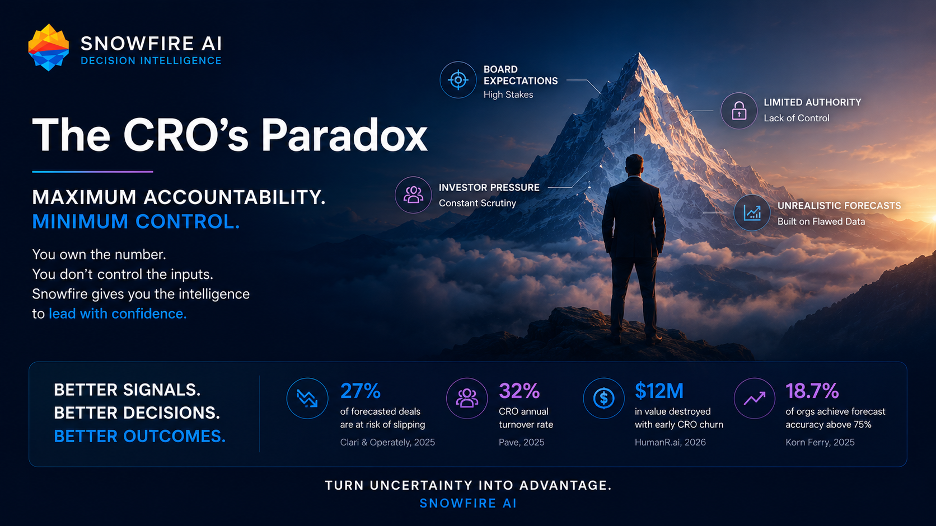
The CRO's Paradox
CROs carry full revenue accountability with fragmented authority, unreliable CRM data, and channel blind spots — why the most scrutinized executive is also the most structurally handicapped.
Read article →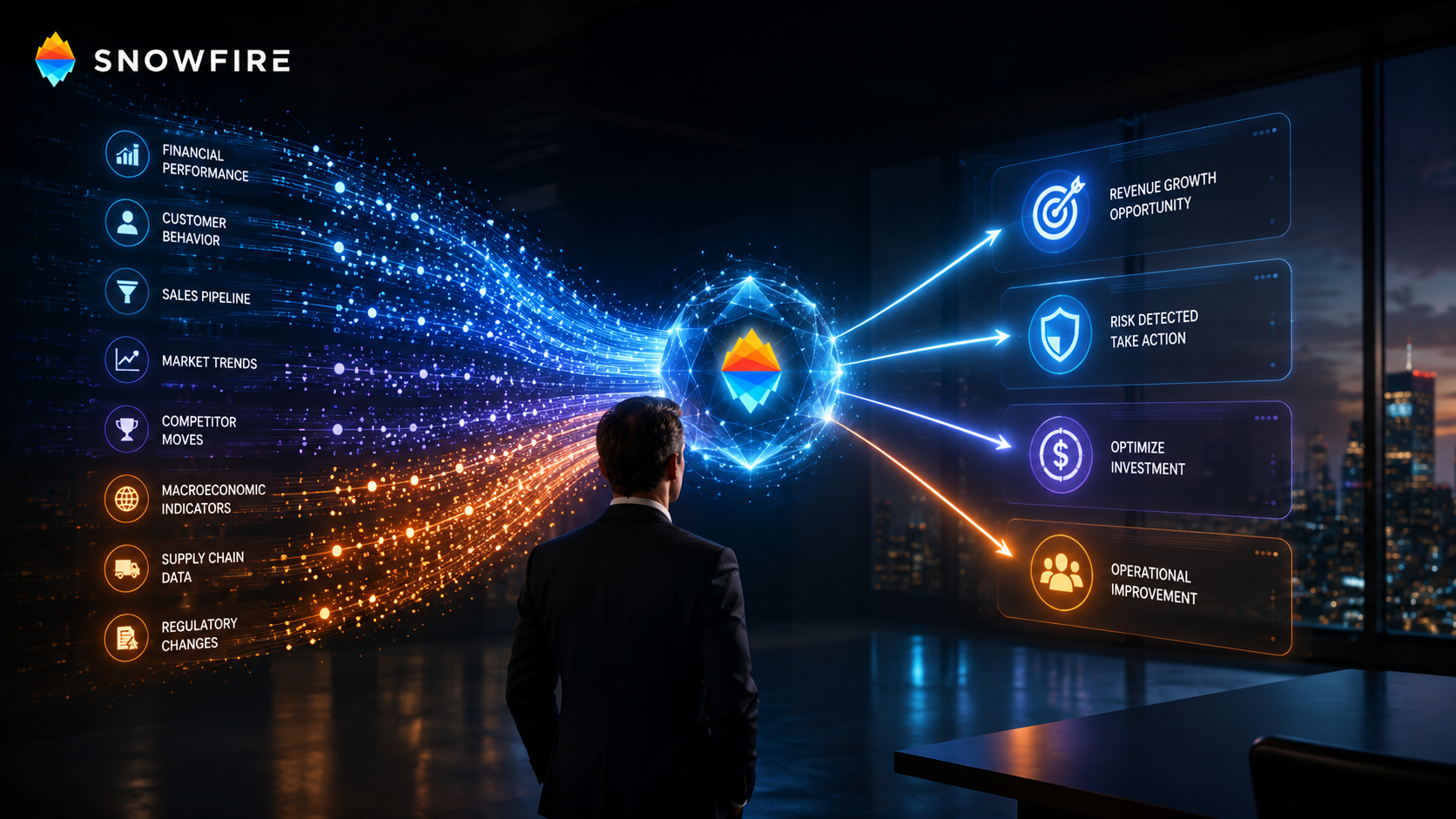
How Adaptive Decision Intelligence Turns Signals Into Actions
Adaptive decision intelligence monitors internal and external signals continuously and pushes role-specific recommended actions—without manual dashboard review.
Read article →