What Is Role-Based Decision Visibility for Executives?
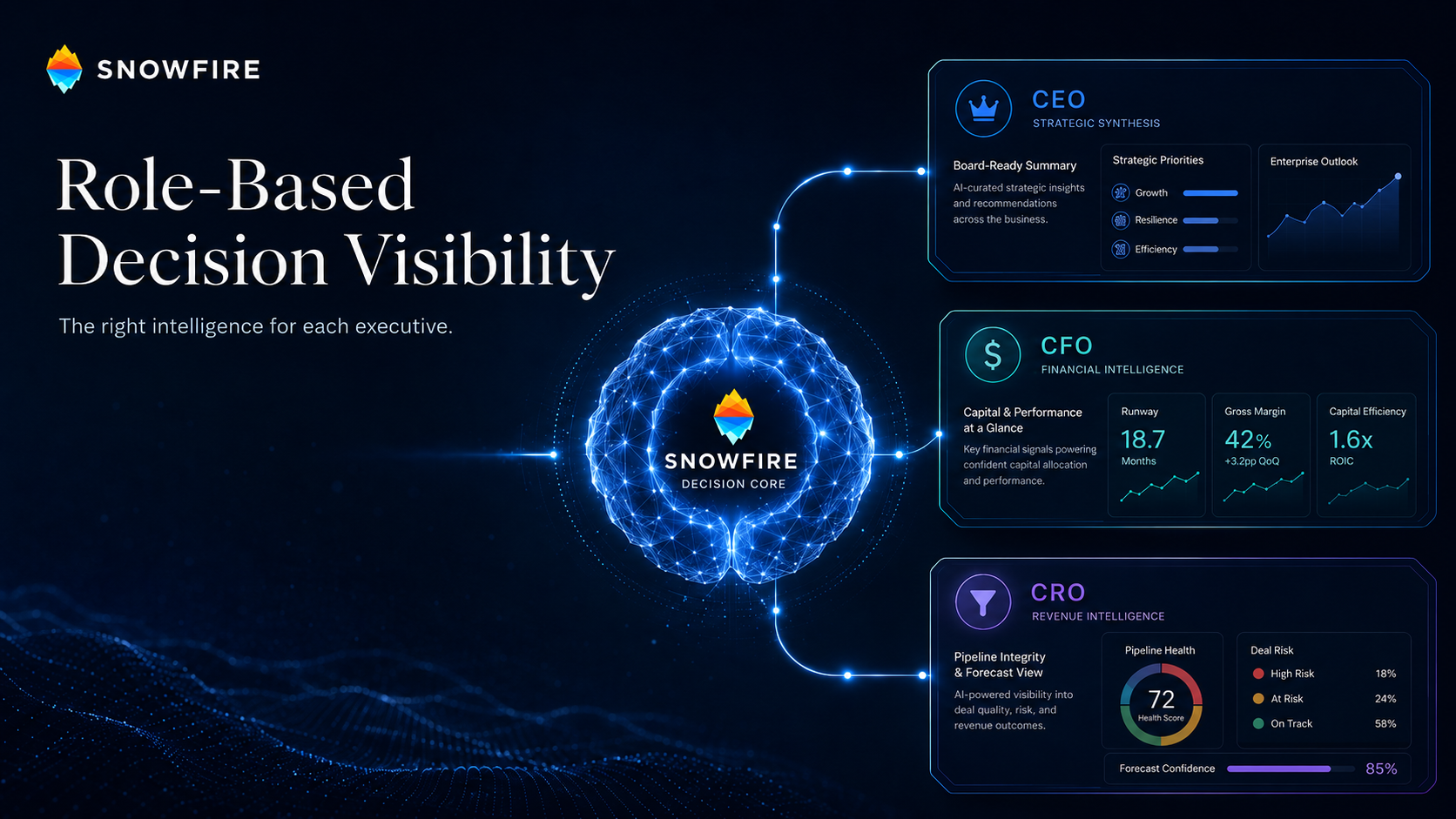
Role-based decision visibility is a capability within executive decision intelligence platforms that delivers filtered, authority-scoped intelligence to each C-suite leader based on their specific decision domain — rather than routing all executives to a shared, undifferentiated data view.
A CFO receives fundraising preparation analytics and capital risk signals. A CRO receives pipeline integrity and deal-level risk data. A COO receives operational constraint and capacity gap intelligence.
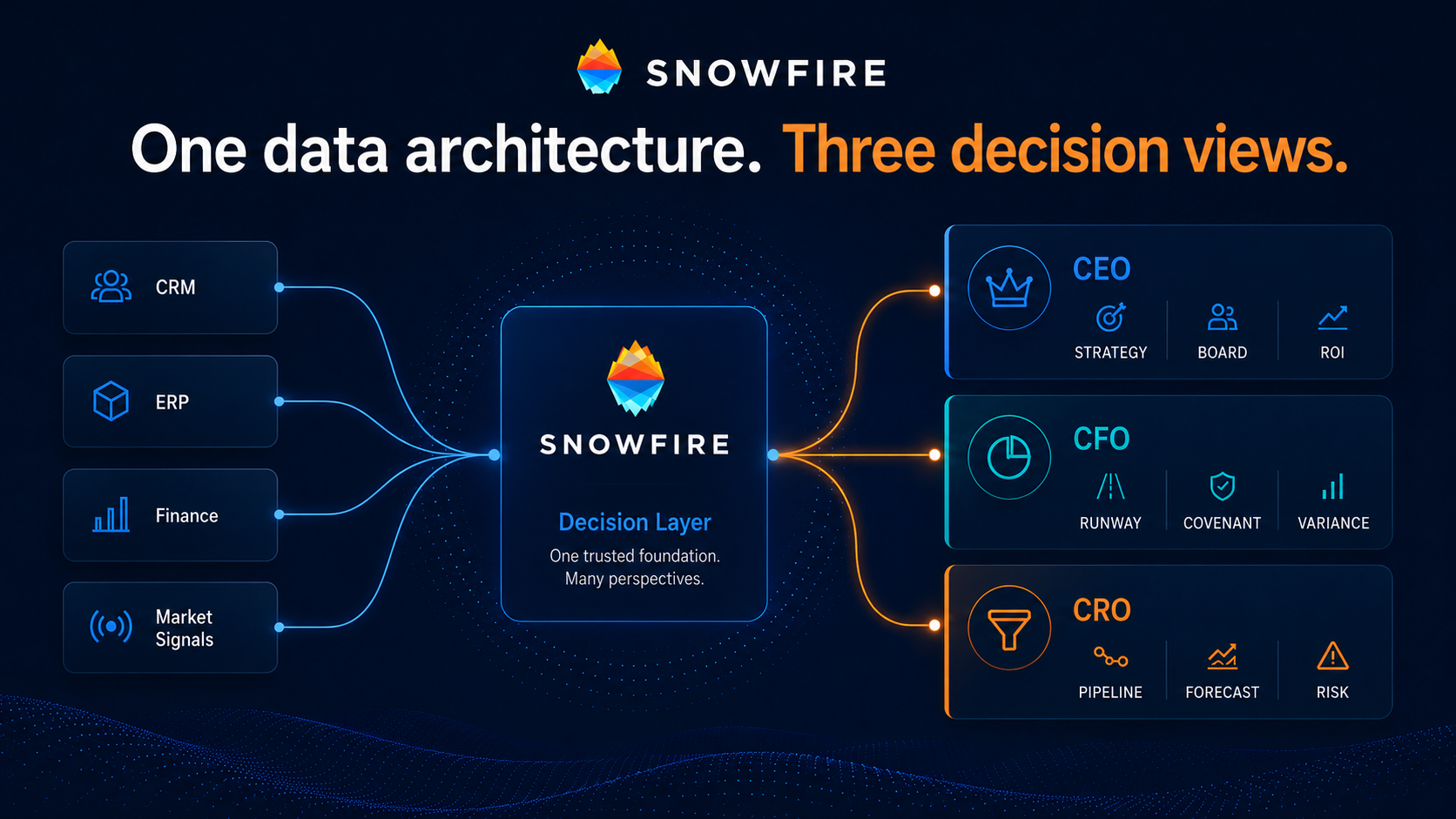
All from the same data architecture. All through role-specific views.
Why Is Executive Intelligence Failing Despite Record AI Investment?
Enterprises are investing heavily in AI. But the intelligence still is not reaching C-suite decision-makers in a form they can act on. The data across recent C-suite research is consistent:
- 87% of CFOs say AI will be extremely or very important to their finance operations in 2026 — yet 46% of FP&A time is still spent on manual data collection and validation. (Deloitte Q4 2025 CFO Signals Survey; AFP FP&A Benchmarking Survey 2025)
- Only 25% of enterprise AI initiatives have delivered expected ROI. 56% of CEOs report no significant financial benefit from AI investment at all. (IBM 2025 CEO Study; PwC 29th Annual Global CEO Survey 2026)
- 63% of organizations lack the data management practices required to support AI-driven executive decisions. (Gartner, February 2025)
- Only 41% of CEOs, CFOs, and COOs report above-average trust in AI for executive decision-making. (Capgemini Research Institute, January 2026)
- 96% of FP&A teams still use spreadsheets for planning and daily reporting. (AFP FP&A Benchmarking Survey 2025)
The pattern is consistent across executive functions: AI investment has happened. Executive-level intelligence has not arrived. Role-based decision visibility is the architectural layer that closes that gap.
How Does Role-Based Decision Visibility Work Across Executive Functions?
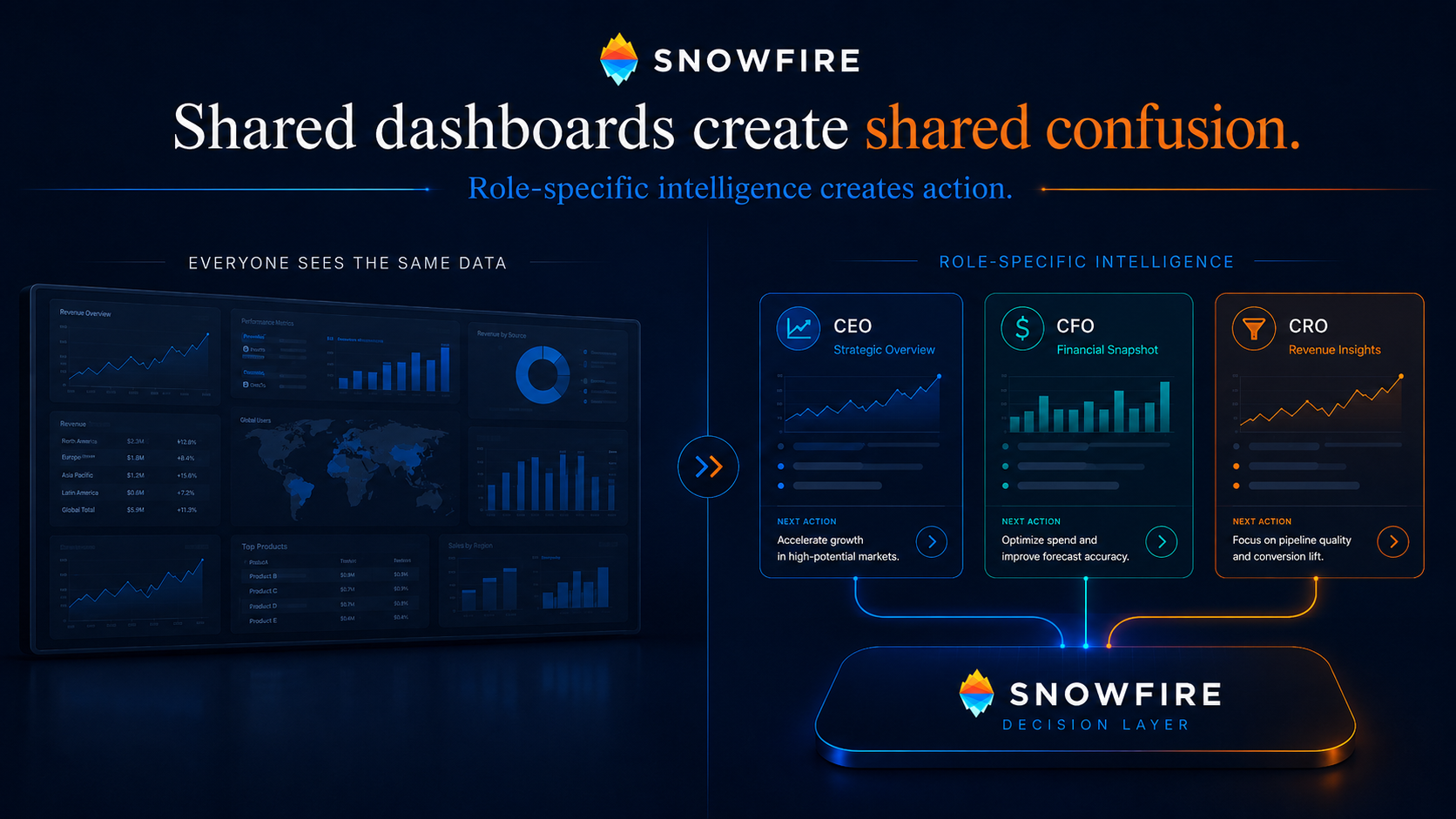
The same underlying data architecture surfaces different intelligence views depending on the executive's role, authority scope, and the decisions they are accountable for.
| Executive role | Decision domain | Intelligence delivered | Current state without it |
|---|---|---|---|
| CEO / President | Enterprise direction, board AI mandate | Cross-functional synthesis, AI ROI attribution, board-ready scenario framing | No unified view exists across functions. Executives interpret the same data through different lenses and arrive at different conclusions. |
| CFO | Capital allocation, investor readiness | Burn/runway modeling, covenant compliance, fundraising preparation analytics | FP&A manually assembles investor-grade views from 6+ disconnected systems before every board cycle. |
| CRO / VP Sales | Revenue health, pipeline integrity, competitive intelligence | Deal-level risk signals, forecast accuracy, competitive move alerts | Reps wait 3–5 days for analytics responses that arrive after the deal has already moved. |
| CEO / Founder (Fundraising) | Investor readiness, board deck, data room | Investor-ready metrics, role-based access controls, cohort and retention views | Investor asks for metrics. 2–4 week manual compilation across 10+ tools. Momentum shifts before the data arrives. |
| CFO / CRO (Financial Services) | Portfolio margin, regulatory intelligence, relationship banking | Real-time margin analysis, regulatory flag synthesis, relationship health scoring — within an isolated data environment | AI investment deployed at the infrastructure layer. Executive-layer intelligence never materialized. Security requirements block external tools. |
Why Do Decision Intelligence Platforms Fail During Crises?
The core failure mode
The most common failure mode is not missing data — it is data that exists but does not reach the right decision-maker in the right form at the right time.
80% of CEOs say AI will force a high-to-medium degree of change to their operational capabilities. (Gartner CEO and Senior Business Executive Survey, 469 executives, April 2026) Yet only 27% of executives have a comprehensive AI strategy, and just 20% believe their workforce is truly AI-ready. (Gartner CxO Survey, December 2025)
What role-based visibility changes
When a crisis hits — supply chain disruption, regulatory action, market shock — platforms requiring manual configuration to surface executive-relevant intelligence are too slow.
Role-based visibility ensures every executive's view is operational before the crisis begins. The COO's constraint intelligence and the CFO's cash impact analysis surface simultaneously from the same platform, without coordination overhead.
Gartner projects 75% of Global 500 companies will deploy decision intelligence practices by 2026, with 33% already operational. Organizations without pre-configured role-based infrastructure are assembling crisis response from scratch under pressure.
The revenue intelligence gap
For revenue leaders, the failure is structural. Deloitte's State of AI report — 3,235 leaders across 24 countries — found 53% of organizations enhanced decision-making through AI, but only 20% achieved measurable revenue impact.
The gap between AI deployment and revenue outcome is the intelligence bottleneck: data that exists inside the CRM and marketing stack but never reaches the forecast call or the rep conversation in unified, real-time form.
What Does Role-Based Decision Visibility Mean for Fundraising Preparation?
Why fundraising exposes your intelligence architecture
Fundraising due diligence is the highest-stakes environment for executive decision intelligence — and the most punishing place for data misalignment across roles.
The evidence from EY's Private Equity Exit Readiness Study 2025 is clear:
- 72% of PE firms identify weak data and KPI reporting as the single biggest finance issue at exit.
- 65% struggle to accurately reflect value creation initiatives in reported EBITDA.
- 41% lack sufficient data granularity to substantiate their equity story to buyers.
83% of investment professionals say their due diligence process needs fixing, and timelines have grown by one to three months for 59% of practitioners. (Woozle Research, January 2026)
Investors ask the same questions across multiple C-suite conversations. When a CFO and CRO draw from different interpretations of the same underlying data, due diligence surfaces it — and deals stall or reprice.
What Snowfire AI delivers for fundraising
Snowfire AI's fundraising preparation analytics make investor-ready intelligence operational before the first investor conversation begins:
- CFO: burn/runway modeling, covenant compliance, investor-grade scenario sensitivity
- CEO: board-ready narrative synthesis — what the data supports, what the material risks are
- CRO: retention cohorts, expansion velocity, churn causality — the growth questions investors actually ask
Every executive draws from the same data architecture, with role-appropriate framing on top. The misalignment that typically derails due diligence is eliminated at the architecture level — not patched in the week before the process begins.
For financial services organizations
The same architecture applies at portfolio scale: real-time margin analysis, regulatory flag synthesis mapped to OCC/FFIEC/Basel III requirements, and relationship health scoring — within an isolated data environment where no data leaves the organization and no external model is trained on internal data.
What Is the Decision Intelligence Market Size in 2026?
The global decision intelligence market was valued at $16.34 billion in 2025 and is projected to reach $68.20 billion by 2035 at a CAGR of 15.36%. (Precedence Research, January 2026)
Gartner projects 75% of Global 500 companies will deploy decision intelligence practices by 2026, with 33% already operational. Deloitte's 2026 State of AI report found 66% of organizations achieved measurable productivity gains from AI — but the gap between operational AI and executive-layer decision intelligence remains the primary unresolved challenge across enterprise organizations.
Snowfire AI addresses that gap — converting enterprise data into role-calibrated intelligence for C-suite leaders, with no data sent to a public LLM.
Frequently Asked Questions
What is role-based decision visibility?
Role-based decision visibility delivers filtered, authority-scoped intelligence to each C-suite leader based on their decision domain — so a CFO receives investor-ready capital intelligence, a CRO receives real-time revenue risk signals, and a CEO receives board-ready strategic synthesis, all from the same underlying data architecture.
What is the difference between role-based decision visibility and a BI dashboard?
BI dashboards answer "what happened" and deliver the same view to everyone. Role-based decision visibility answers "what should happen next" and delivers role-specific intelligence proactively to each executive based on their decision authority — not a shared feed that every leader has to interpret through their own lens.
Why do decision intelligence platforms fail during crises?
Primarily because executive-facing intelligence views are not pre-configured by role. Under time pressure, platforms requiring manual configuration cannot match the decision velocity required. Role-based visibility solves this by ensuring each executive's view is operational before the crisis begins — not assembled during it.
What does role-based decision visibility mean for CROs and revenue leaders?
For revenue leaders, it eliminates the intelligence bottleneck: deal-level risk signals, competitive move alerts, and forecast accuracy data surface in real time without routing every request through an analyst queue. Intelligence moves at the speed of the deal, not the speed of the IT ticket.
What does role-based decision visibility mean for FP&A leaders?
It means fundraising preparation analytics, covenant compliance, scenario models, and budget variance intelligence in a single pre-configured view — eliminating the 46% of FP&A time currently spent on manual data collection before each board cycle. (AFP FP&A Benchmarking Survey, 2025)
How does role-based decision visibility handle data security for financial services organizations?
For banks, insurers, and asset managers, role-based decision visibility requires isolated data infrastructure — with RBAC at source, table, and field level. The architecture aligns with OCC, FFIEC, and Basel III requirements, supports FedRAMP-compatible deployment, and ensures no data trains an external model.
What is the decision intelligence market size in 2026?
The global decision intelligence market was valued at $16.34 billion in 2025, projected to reach $68.20 billion by 2035 at a 15.36% CAGR. (Precedence Research, January 2026) Gartner projects 75% of Global 500 companies will adopt decision intelligence practices by 2026, with 33% already operational as of the 2024 CDAO Agenda Survey.
How is an executive decision intelligence platform different from Salesforce Agentforce or Microsoft Copilot?
Agentforce automates Salesforce workflows. Copilot accelerates individual productivity within Microsoft applications. Executive decision intelligence platforms operate above the entire stack — unifying CRM, ERP, finance, marketing, and external market signals into role-specific intelligence for C-suite decision-makers. These tools operate inside a single system. Decision intelligence connects every system to every decision.
Sources
- Deloitte — Q4 2025 CFO Signals Survey (January 2026)
- IBM Institute for Business Value — 2025 CEO Study
- PwC — 29th Annual Global CEO Survey 2026
- Gartner — CEO and Senior Business Executive Survey (April 2026)
- Capgemini Research Institute — How AI Is Reshaping Executive Decisions (January 2026)
- AFP — 2025 FP&A Benchmarking Survey: Technology and Data
- EY — Private Equity Exit Readiness Study 2025 (April 2026)
- Woozle Research — Why 83% of Investment Professionals Say Due Diligence Needs Fixing (January 2026)
- Precedence Research — Decision Intelligence Market 2025–2035 (January 2026)
Related articles
What Would 80% Faster Decisions Mean for Your Business?
AI is moving into enterprise decision-making. Learn where decision intelligence can help leaders turn existing business signals into faster, better-informed decisions.
Read article →
59% of CFOs Are Caught Between AI Speed and AI Risk
59% of CFOs say balancing AI deployment speed with risk is their biggest AI governance challenge. See what that means for enterprise AI adoption.
Read article →
Where Is AI Actually Worth the Investment?
See where AI could create value in your business. Snowfire Transform builds a personalized assessment, estimated ROI, and 90-day roadmap in about 30 seconds.
Read article →