59% of CFOs Are Caught Between AI Speed and AI Risk
AI adoption isn't slowing down. But for enterprise leaders, moving faster comes with a harder question: How do you put AI to work without taking on more risk?
In Deloitte's latest survey of 200 CFOs at North American companies with at least $1 billion in revenue, 59% said their biggest challenge to enterprise-wide AI governance is balancing pressure to deploy AI quickly while managing risk.
93% are already using AI across multiple key functions and operations. The pressure now is to turn that adoption into meaningful business value.
The stakes change when AI starts informing decisions
Using AI to summarize a meeting or draft an email is one thing. Using it to understand why margins are slipping, where pipeline is weakening, or whether a market shift requires action is another.
The more consequential the decision, the more important it becomes to know what the answer is based on.
Is it using the right data? Does it understand how the business defines its metrics? Can you trace the answer back to its source? Is proprietary company intelligence protected?
If AI is informing decisions about revenue, margin, or risk, leaders need to be able to trust the answer and trace where it came from.
And CFOs are already confronting that issue. Nearly half cited cost uncertainty or lack of transparency as their biggest internal concern about AI, while cybersecurity ranked among their top external concerns.
Moving faster shouldn't mean lowering the bar
Enterprises have spent years building technology stacks, data infrastructure, security controls, and governance processes around the way their businesses operate.
AI has to work within that reality.
That means the path to enterprise AI is putting AI to work with the company's existing data and systems while preserving the controls required to use that intelligence with confidence.
That's the approach behind Snowfire.
Snowfire works across an enterprise's existing technology stack to turn proprietary business data and external signals into decision-ready intelligence. Governed business definitions and auditable SQL make it possible to trace how an answer was produced, while isolated customer environments keep proprietary intelligence proprietary.
Making enterprise AI easier to put to work
It's also why Snowfire is partnering with Technologent, a global IT solutions and services provider serving Fortune 1000 companies.
Through the partnership, Technologent will bring Snowfire into enterprise environments alongside the infrastructure, systems, and security requirements already in place.
For Snowfire, the partnership addresses a practical part of enterprise AI adoption: companies don't just need technology that works. They need a clear path to evaluate it, deploy it, and use it within the security and governance requirements they already have.
That matters when the goal is to get useful intelligence into the hands of decision-makers sooner without asking the enterprise to compromise how its data is protected or governed.
Sources
Related articles
What Would 80% Faster Decisions Mean for Your Business?
AI is moving into enterprise decision-making. Learn where decision intelligence can help leaders turn existing business signals into faster, better-informed decisions.
Read article →
Where Is AI Actually Worth the Investment?
See where AI could create value in your business. Snowfire Transform builds a personalized assessment, estimated ROI, and 90-day roadmap in about 30 seconds.
Read article →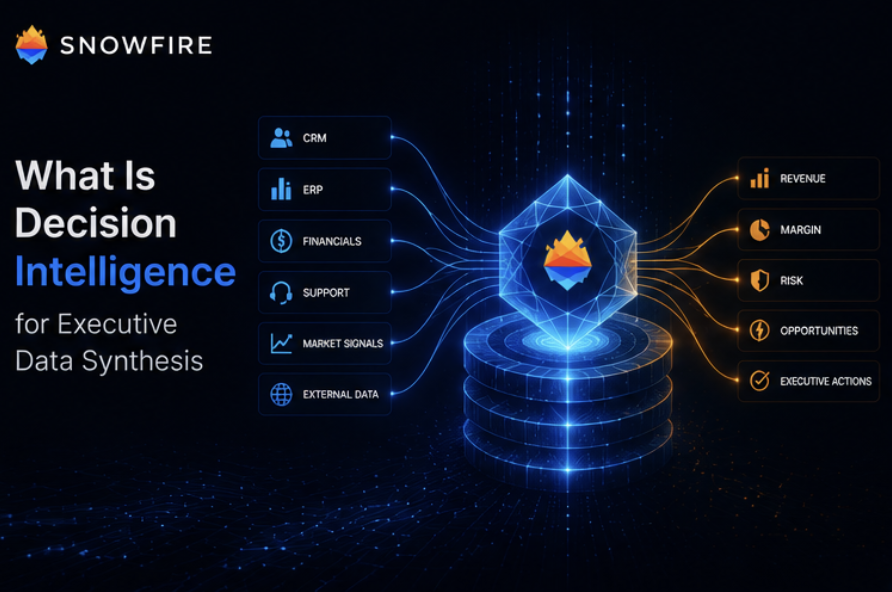
What Is Decision Intelligence for Executive Data Synthesis
Decision intelligence converts organisational data into prioritised, executable recommendations—replacing manual analysis with structured AI reasoning mapped to business outcomes.
Read article →