What Would 80% Faster Decisions Mean for Your Business?
AI has spent the past few years helping enterprises find information, analyze data, and answer questions faster. Now it's moving into the decisions themselves.
Gartner predicts that "by 2027, 50% of business decisions will be augmented or automated by AI agents for decision intelligence" (Gartner Press Release, June 17, 2025). Additionally, the firm estimates "explicitly modeled business decisions will be five times more trusted and 80% faster than ungoverned decisions by 2029, enabled by decision intelligence platform adoption" (Gartner Press Release, June 16, 2026).
The question for enterprise leaders is which decisions in your business would materially improve if you could make them faster and with greater confidence?
Look for the gap between knowing and acting
Some decisions take time because the answer genuinely isn't clear. A major acquisition or market entry requires judgment, debate, and an acceptance of uncertainty. Making that decision faster isn't necessarily better.
Other decisions are slow for a different reason.
The business already has the signals, they're just scattered across systems, reports, teams, and external sources. Someone has to find them, connect them, determine what changed, and explain why it matters before leadership can act.
In our view at Snowfire, addressing this gap requires an adaptive approach to decision intelligence.
Take pipeline. A CRO may have revenue targets in one system, pipeline performance in another, customer conversations happening across the sales organization, and competitive changes developing outside the company. A slowdown rarely announces itself neatly. Its significance becomes clear when those signals are understood together.
If that happens during a forecast review weeks later, leadership can explain the miss. But if it happens as the pattern is developing, the sales organization can do something about it.
The same test applies elsewhere in the business. Margin is slipping, but finance needs to reconcile several sources before it can isolate why. Customer risk is rising, but the evidence is spread across usage, support, and account data. A competitor changes pricing, but its potential impact isn't connected to what sales teams are hearing from customers.
In each case, more data isn't the answer. The information already exists. The problem is how long it takes to turn it into a decision.
Find where waiting costs you
Gartner recommends that organizations identify the decisions most critical to the business and determine where analytics and AI could improve them.
Consider consequential decisions where the business has the signals it needs, but can't connect, interpret, and act on them fast enough.
Where are leaders regularly waiting for an answer? Which questions require several teams or systems to piece together? Where does the business eventually understand what happened, but too late to do anything about it?
Those are the places where faster decision-making has a measurable value.
An 80% faster decision isn't meaningful because it saves a few hours of analysis. It's meaningful when those hours, days, or weeks give the business time to protect revenue, respond to a customer, address margin pressure, or act before a risk becomes a result.
Sources
- Gartner Press Release, "Gartner Announces the Top Data & Analytics Predictions" (June 17, 2025)
- Gartner Press Release, "Gartner Identifies the Top Trends for Data and Analytics" (June 16, 2026)
GARTNER is a registered trademark and service mark of Gartner, Inc. and/or its affiliates in the U.S. and internationally and is used herein with permission. All rights reserved.
Related articles
59% of CFOs Are Caught Between AI Speed and AI Risk
59% of CFOs say balancing AI deployment speed with risk is their biggest AI governance challenge. See what that means for enterprise AI adoption.
Read article →
Where Is AI Actually Worth the Investment?
See where AI could create value in your business. Snowfire Transform builds a personalized assessment, estimated ROI, and 90-day roadmap in about 30 seconds.
Read article →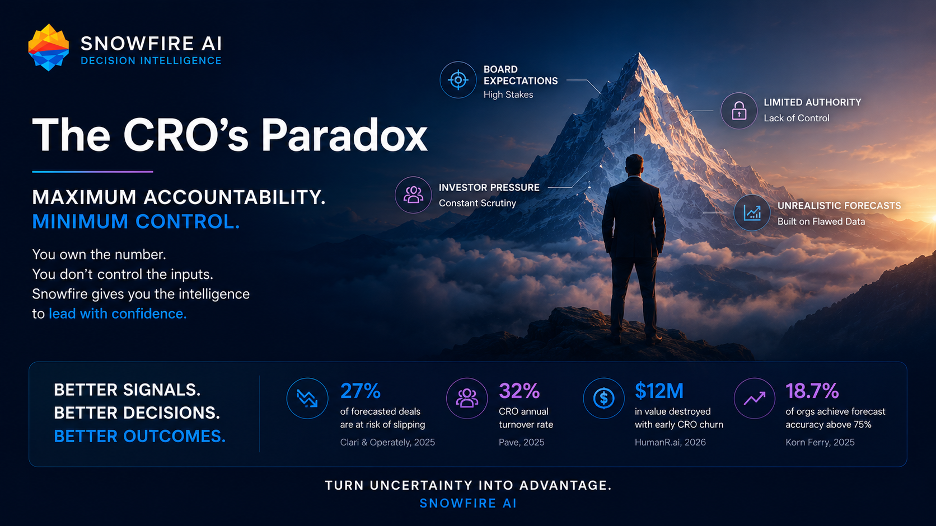
The CRO's Paradox
CROs carry full revenue accountability with fragmented authority, unreliable CRM data, and channel blind spots — why the most scrutinized executive is also the most structurally handicapped.
Read article →