How to Evaluate AI Decision Intelligence Platforms in 2026
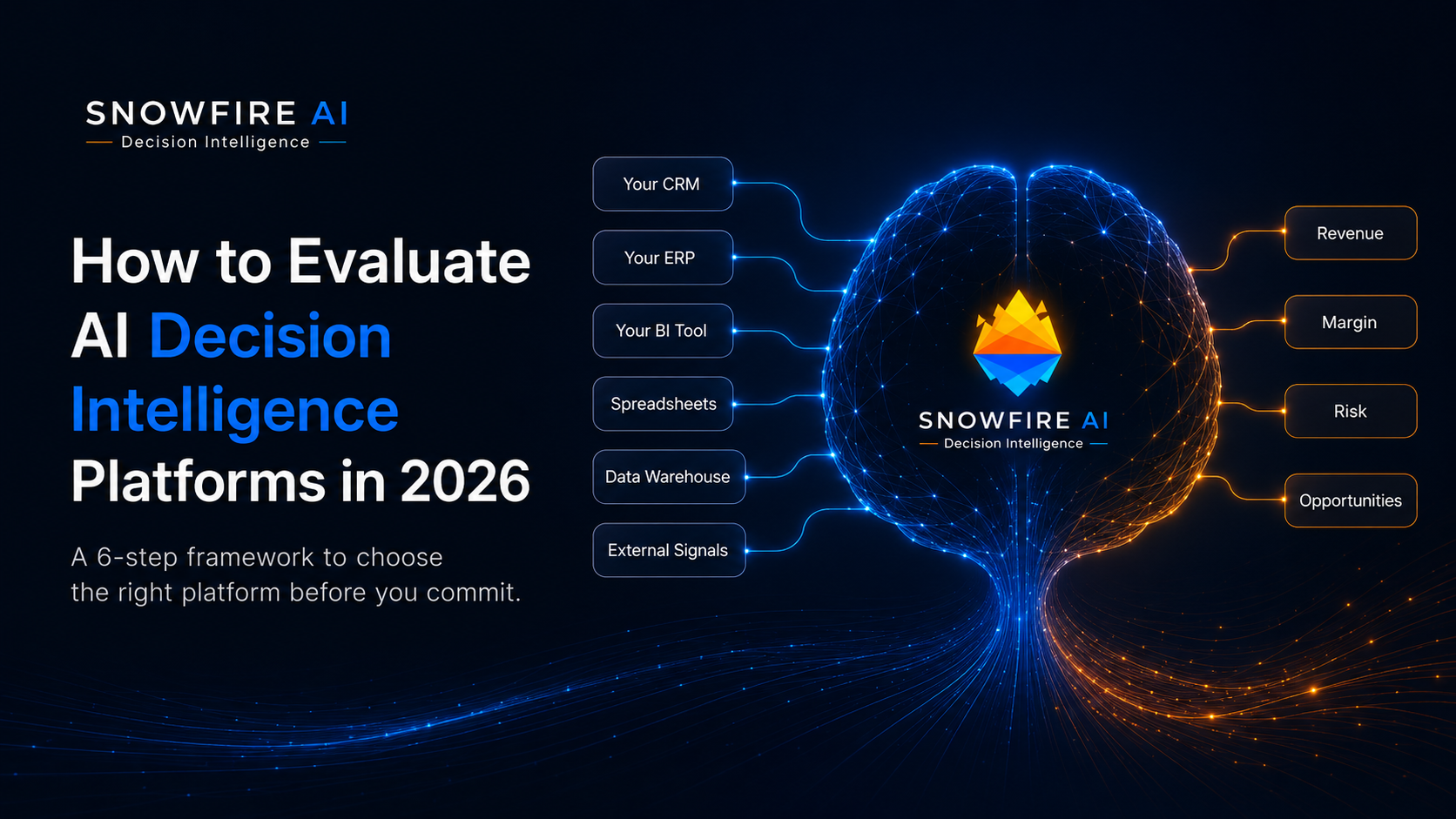
An AI decision intelligence platform evaluation framework measures a platform's ability to unify internal metrics with external market signals, surface recommended actions by executive role, meet enterprise security requirements, and deploy within an operational timeline — before a procurement commitment is made.
In 2026, getting this evaluation wrong is expensive. Getting it right is faster than most enterprise procurement teams assume.
Why Have Platform Selection Decisions Raised Stakes in 2026?
The selection environment has shifted: more platforms, higher spend, faster decisions, and a documented failure rate that makes evaluation rigor the primary risk-reduction lever available to enterprise CIOs.
- Worldwide AI spending will reach $2.59 trillion in 2026 — a 47% increase year-over-year. Enterprise AI selection decisions are larger, faster, and more irreversible than 18 months ago. (Gartner, May 2026)
- 30% of generative AI projects will be abandoned after proof of concept by end of 2025 — due to poor data quality, inadequate risk controls, escalating costs, or unclear business value. (Gartner, July 2024)
- Only 28% of AI use cases in infrastructure and operations fully succeed and meet ROI expectations. 20% fail outright. (Gartner, April 2026, 782 I&O leaders)
- 80% of enterprises cite data integration as their most significant obstacle when deploying AI. The average enterprise manages 897 applications — yet only 29% are integrated. (MuleSoft 2025 Connectivity Benchmark, 1,050 IT leaders)
- Only 48% of digital initiatives meet or exceed their business outcome targets enterprise-wide. (Gartner CIO and Technology Executive Survey, 3,186 respondents, October 2024)
- 80% of CIOs are now personally spearheading AI platform research and evaluation — and 44% of IT leaders use AI tools as their primary method for assessing vendor options. (Foundry/IDC State of the CIO 2025)
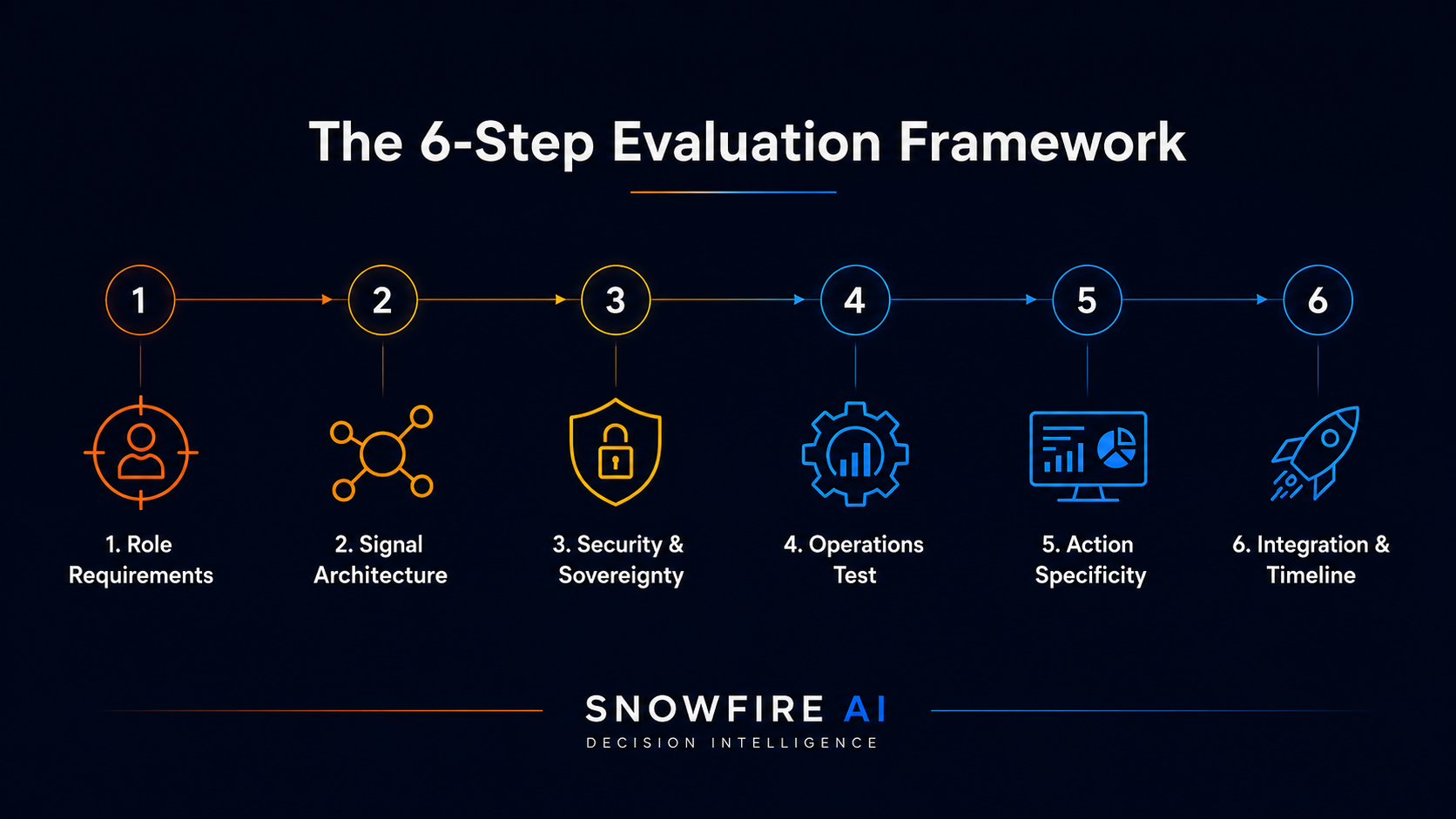
What Is the 6-Step Evaluation Framework for AI Decision Intelligence Platforms?
Step 1: Define Intelligence Requirements by Executive Role
Before evaluating any platform, map what each executive role actually needs — not what the platform claims to deliver.
For each C-suite function, document:
- Which decisions they make on what timeline
- Which data sources currently inform those decisions
- Where intelligence gaps or latency exist
- What a recommended action looks like for their specific domain
A CFO needs capital allocation intelligence, investor-ready scenario modeling, and covenant compliance status. A CRO needs deal-level risk signals, competitive intelligence, and forecast accuracy data before deals move. A COO needs constraint visibility and operational risk flags before they hit margin.
Any platform that cannot articulate role-specific intelligence delivery against these requirements in a live demo — on your data — fails at Step 1.
Step 2: Evaluate Signal Architecture — Internal and External
A decision intelligence platform that monitors only internal data delivers half the picture. Market conditions, competitor moves, regulatory changes, and macroeconomic signals are what make internal metrics meaningful.
Evaluate:
- Does the platform ingest both internal systems and external signal feeds simultaneously?
- Is signal monitoring continuous or batch-processed on a schedule?
- How does the platform detect conditions at the intersection of internal and external signal thresholds?
- What is the latency between a signal change and an executive alert?
A platform that requires manual queries to surface external intelligence is a BI tool with a decision intelligence label.
Step 3: Assess Data Sovereignty and Security Architecture
Security is the #1 CIO priority for the fourth consecutive year. 69% of organizations have prohibited public AI tools — making data sovereignty a non-negotiable evaluation criterion, not a secondary concern. (Gartner 2025 CIO Agenda)
Evaluate:
- Does the platform operate on isolated, organization-specific data storage — or does it route data through shared or public model infrastructure?
- Is the platform SOC 2 compliant with RBAC at the source, table, and field level?
- Does the vendor's AI model train on your organizational data in any configuration?
- For financial services: does the architecture align with OCC, FFIEC, and Basel III requirements?
Any platform that cannot provide a clear, documented answer to "does our data train your model" should be disqualified at this step.
Step 4: Test Operations Optimization Capability
Operations optimization requires the platform to detect external constraints before they materialize internally. This is the test that separates adaptive decision intelligence from reactive dashboards.
Evaluate with a live scenario: present a real operational constraint your organization has faced — a supply disruption, a capacity breach, a regulatory change — and ask the platform to demonstrate how it would have detected the precursor signals and surfaced the recommended action to the COO before the constraint materialized.
If the platform can only show you what happened after the fact, it is not operating as adaptive decision intelligence. It is operating as a faster version of the reporting cycle you already have.
Step 5: Evaluate Executive Dashboard and Action Specificity
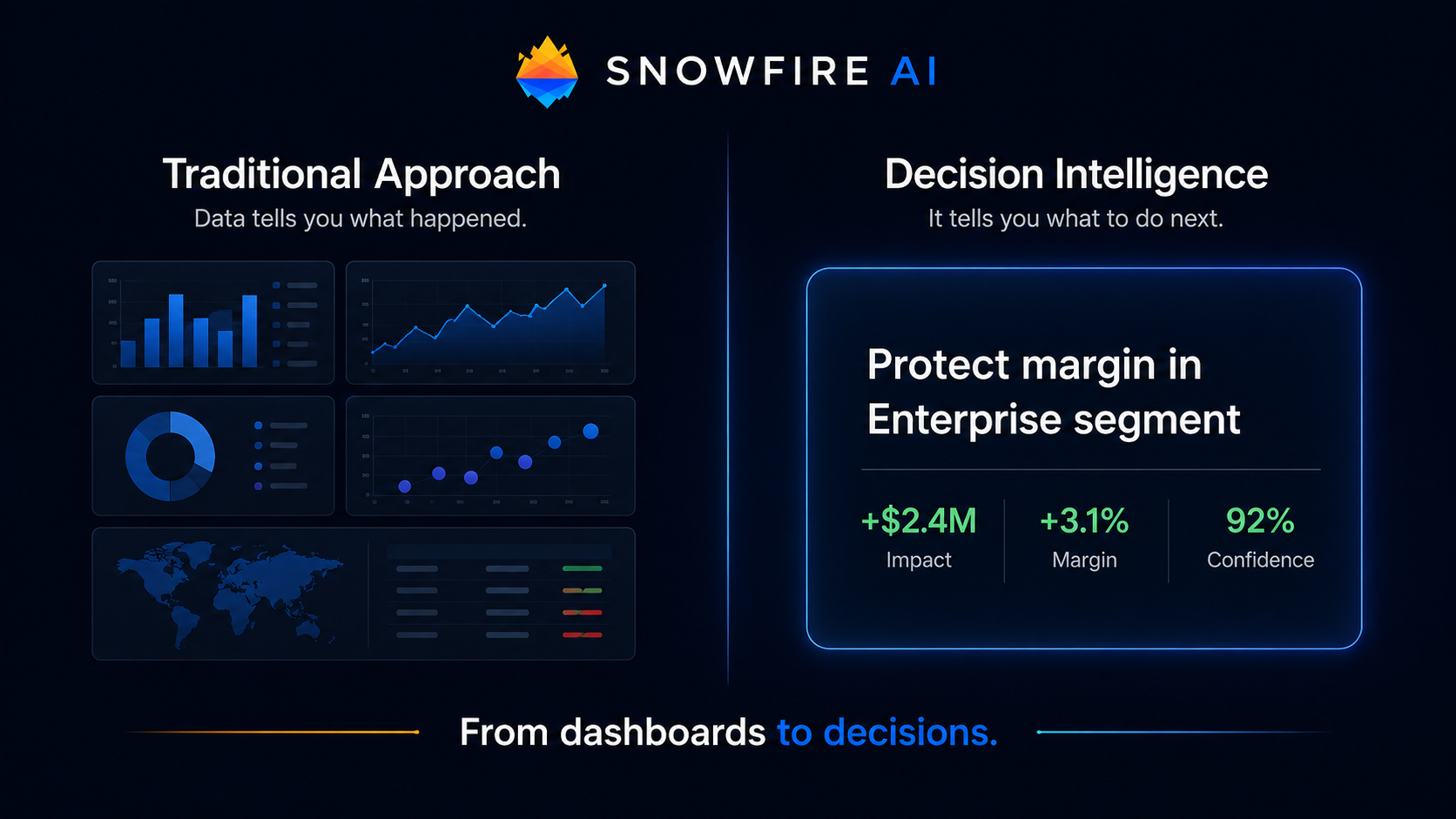
The central evaluation question for executive dashboards is not "what does this show?" — it is "what does this tell the executive to do?"
Evaluate:
- Does the platform surface a specific recommended action, or a data summary requiring executive interpretation?
- Are dashboard views role-specific — pre-configured for each executive's decision authority — or do they require individual navigation?
- Does the platform push intelligence proactively via Slack, mobile, or email — or does it require the executive to log in and look?
- Can the platform demonstrate three live examples of recommended actions for a CFO, CRO, and COO — with full data lineage on each?
A platform that answers "here is your data" when asked "what should I do" has failed this evaluation.
Step 6: Validate Integration Breadth and Deployment Timeline
Integration complexity is the primary reason AI deployments fail after selection. 95% of organizations face challenges integrating AI into existing processes. (MuleSoft 2025)
A platform that requires custom engineering to connect your CRM, ERP, and financial systems before producing any executive intelligence is not a 30-day deployment — it is an 18-month project wearing a vendor's timeline estimate.
Evaluate:
- How many pre-built connectors does the platform offer — specifically for your existing stack?
- What is the realistic timeline to first live executive intelligence view, with no custom engineering?
- What happens when a connected source changes its schema or API — is that a manual fix or an automated update?
- Can the vendor reference a customer live within 30 days on a comparable stack to yours?
Platform Comparison: Key Evaluation Dimensions
The table below reflects Snowfire AI's official platform comparison. Full details are available on our platform comparisons page.
| Criteria | Snowfire AI | Quantexa | Domo | Palantir |
|---|---|---|---|---|
| Time to first insight | 30 days | 3–6 months | 4–8 weeks | 6–18 months |
| Data sovereignty | Full isolation — your environment only | Cloud-dependent | Cloud-dependent | Partial — Foundry cloud |
| ICP fit | CEO, CFO, CRO, PE-backed firms, Finance | Financial crime, regulated banking | Mid-market ops | Government, large enterprise |
| Integration model | Connects to existing stack | Custom build required | Native connectors | Full Foundry migration |
| AI explanation layer | Role-specific, plain-language | Technical output | Dashboard-level | Analyst-mediated |
| Outcome accountability | ROI commitments in SOW | Professional services model | Usage-based | Long-term contract lock-in |
Red Flags: Disqualify Early
These signals appear in vendor conversations before contract. Each one predicts a specific failure mode after deployment.
| Red flag | What it means |
|---|---|
| Cannot demo on your data in the first meeting | The platform requires weeks of setup before producing any executive intelligence — deployment timeline claims are not credible |
| "Recommended actions" are dashboard summaries | The platform is a BI tool. It shows data, not decisions. |
| Data sovereignty answer is vague or deferred | Your organizational data will touch external model infrastructure in some configuration |
| Integration requires custom engineering for core systems | The 30-day deployment claim applies only to a pre-configured demo environment |
| No role-specific views out of the box | Every executive intelligence view requires manual configuration — the platform is a framework, not a product |
| Comfortable with a 12–18 month deployment timeline | Their delivery model does not match the speed at which executive decisions need to be made |
Snowfire AI is designed to clear every red flag on this list: demo on your data in the first meeting, role-specific views out of the box, full data isolation with ROI commitments in the SOW, 700+ pre-built integrations, and full deployment in 30 days — on your existing infrastructure, with no engineering overhead.
Frequently Asked Questions
What is an AI decision intelligence platform?
An AI decision intelligence platform is enterprise software that continuously monitors internal business metrics and external market signals, detects conditions requiring executive decisions, and surfaces role-specific recommended actions to the relevant C-suite leader — without requiring manual analysis, dashboard review, or analyst intervention.
What criteria should CIOs use to evaluate AI decision intelligence platforms in 2026?
Six criteria: signal architecture (internal and external, continuous versus batch), action specificity (recommended decisions versus data summaries), data sovereignty (isolated storage versus shared model infrastructure), operations optimization capability (precursor signal detection versus reactive reporting), executive dashboard delivery (role-specific proactive push versus shared pull), and integration breadth with deployment timeline validation.
Why do AI decision intelligence platform deployments fail?
The primary failure modes are:
- Poor data quality and integration gaps (30% of GenAI projects abandoned after proof of concept, per Gartner 2024)
- Misaligned role-based access architecture
- Governance frameworks that cannot operate at decision velocity
- Deployment timelines that require 12–24 months before any executive intelligence is live
How is Snowfire AI different from Quantexa for enterprise decision intelligence?
Quantexa specializes in entity-resolution analytics within structured datasets — particularly for financial crime detection and risk analysis in regulated industries. Snowfire AI operates at the executive decision layer: continuously synthesizing internal metrics and external market signals into role-specific recommended actions across all enterprise functions. The use cases do not overlap.
How is Snowfire AI different from Domo for executive dashboards?
Domo is a business intelligence and data visualization platform — it surfaces what your data looks like. Snowfire AI surfaces what your data means and what each executive should do about it next. The distinction is between a tool that answers questions when queried and a platform that detects conditions and pushes the recommended action before the executive has to ask.
What is the realistic deployment timeline for an enterprise AI decision intelligence platform?
Deployment timelines vary significantly by platform architecture. Platforms requiring custom integration engineering typically take 6–18 months before any executive intelligence view is live. Snowfire AI is production-ready in one business day and fully deployed within 30 days — on existing infrastructure, with no custom engineering required and ROI commitments included in the SOW.
Sources
- Gartner — Worldwide AI Spending to Grow 47% in 2026 (May 2026)
- Gartner — 30% of Generative AI Projects Will Be Abandoned After Proof of Concept (July 2024)
- Gartner — AI Projects in Infrastructure and Operations Stall Ahead of Meaningful ROI (April 2026)
- Gartner — Only 48% of Digital Initiatives Meet or Exceed Business Outcome Targets (October 2024)
- MuleSoft / Salesforce — 2025 Connectivity Benchmark Report (2025)
- Foundry / IDC — State of the CIO 2025 (2025)
- Snowfire AI — Platform Comparisons
Related articles
What Would 80% Faster Decisions Mean for Your Business?
AI is moving into enterprise decision-making. Learn where decision intelligence can help leaders turn existing business signals into faster, better-informed decisions.
Read article →
59% of CFOs Are Caught Between AI Speed and AI Risk
59% of CFOs say balancing AI deployment speed with risk is their biggest AI governance challenge. See what that means for enterprise AI adoption.
Read article →
Where Is AI Actually Worth the Investment?
See where AI could create value in your business. Snowfire Transform builds a personalized assessment, estimated ROI, and 90-day roadmap in about 30 seconds.
Read article →