7 Executive Intelligence Tools for Board Reporting
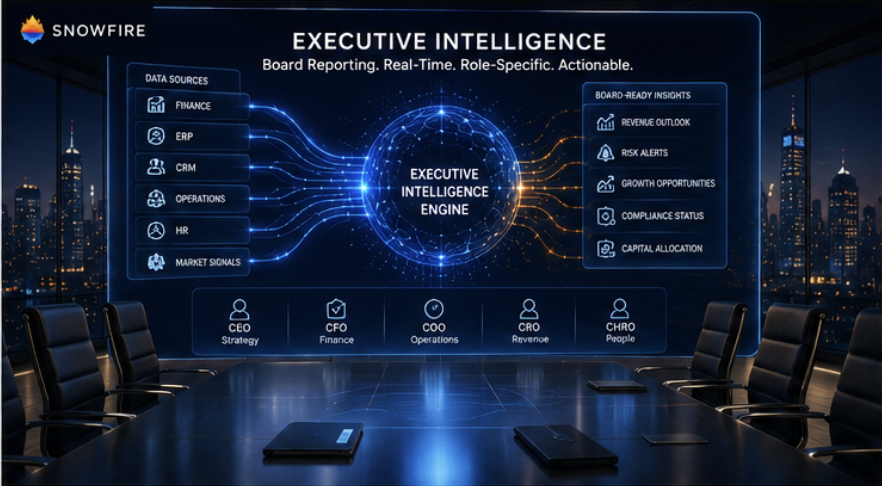
Executive intelligence tools are software platforms that synthesise operational, financial, and strategic data into role-specific signals for senior decision-makers — enabling boards to act on current information rather than last quarter's reports.
What should CFOs and CEOs look for in executive intelligence tools?
Board reporting has a structural problem. Finance teams spend an average of 70% of their time collecting and formatting data, leaving less than 30% for the analysis that boards actually need. The tools that solve this problem share three characteristics: they ingest data from multiple systems without manual exports, they surface exceptions rather than summaries, and they restrict visibility by role rather than by document version.
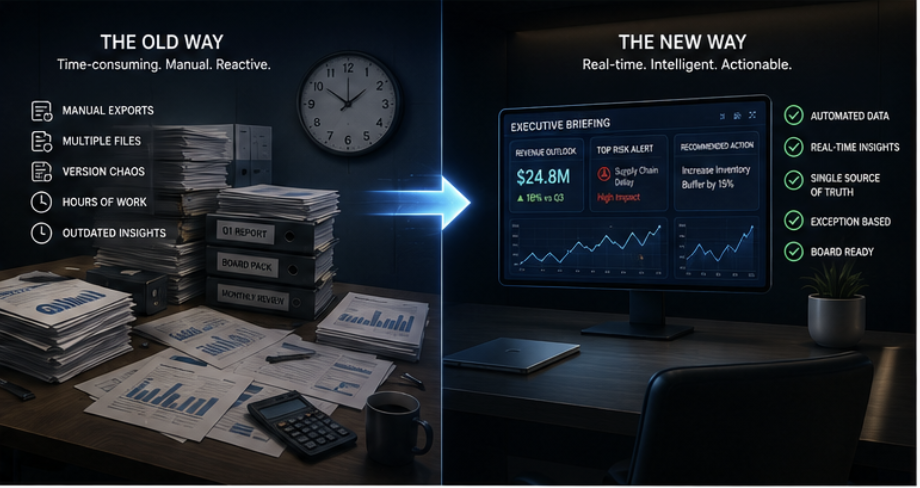
The seven tools ranked below are evaluated against those three criteria, with particular attention to deployment speed, data governance, and the quality of signal synthesis at the executive layer.
How do AI-powered board reporting tools compare across key capabilities?
| Tool | Real-Time Data Ingestion | Role-Based Visibility | AI Signal Synthesis | Deployment Model |
|---|---|---|---|---|
| Snowfire AI | Yes | Yes | Yes | On-premise / Private Cloud |
| Palantir Foundry | Yes | Yes | Partial | Cloud / On-premise |
| Tableau + Einstein | Partial | Partial | Partial | Cloud |
| Microsoft Power BI | Partial | Yes | Partial | Cloud / Hybrid |
| Qlik Sense | Yes | Yes | No | Cloud / On-premise |
| ThoughtSpot | Yes | Partial | Yes | Cloud |
| Domo | Yes | Partial | Partial | Cloud |
7 Executive Intelligence Tools Ranked for Board Reporting
1. Palantir Foundry
Palantir Foundry is the most technically capable platform on this list for large-scale data integration across complex, multi-source environments. Its ontology layer maps relationships between data objects in ways that generic BI tools cannot replicate. For organisations with mature data engineering teams and budgets above $500,000 annually, it delivers a high degree of signal fidelity at the board level. The constraint is cost and implementation time. Palantir's entry price places it outside the consideration set for most growth-stage companies and mid-market organisations. Implementation timelines routinely run 9 to 18 months before executive-layer outputs are production-ready. Boards waiting on AI readiness assessments will not find Foundry a fast answer.
2. Microsoft Power BI (with Copilot)
Power BI remains the most widely deployed executive dashboard tool in enterprise environments. The addition of Copilot in 2024 introduced natural language querying at the report level, allowing executives to ask questions in plain English without relying on analyst intermediaries. According to Microsoft's 2024 Work Trend Index, 75% of knowledge workers are already using AI tools at work, creating an adoption path that Power BI can capitalise on. The limitation for board reporting specifically is the depth of signal synthesis. Power BI surfaces what happened. It does not reliably surface what to do next or which variance matters most to a board-level decision. Finance and compliance teams operating under data sovereignty requirements should note that Power BI's default configuration routes data through Microsoft's cloud infrastructure, which creates residency questions in regulated sectors.
3. Tableau (with Salesforce Einstein)
Tableau's integration with Salesforce Einstein gives revenue-focused executives a connected view from pipeline to board pack. CROs managing ticket bottlenecks and pipeline visibility gaps will find the CRM-to-dashboard connection useful for isolating where deals are stalling and projecting quarter-end positions with more granularity than static spreadsheet models allow. The challenge is that Tableau's board-level output still requires significant configuration to produce the role-gated, exception-first views that governance-conscious boards expect. Licensing costs scale quickly when multiple executive roles require customised views, and the AI synthesis layer remains dependent on the quality of Salesforce data hygiene upstream.
4. ThoughtSpot
ThoughtSpot's search-driven analytics model is one of the strongest implementations of natural language querying available to non-technical executives. A CEO preparing for a board session can type a question directly into the interface and receive a visual answer without opening a support ticket with the data team. According to Forrester's Now Tech: Augmented Intelligence For Customer Analytics, Q2 2024, AI-augmented analytics platforms are reducing time-to-insight by up to 40% compared to traditional BI deployments. ThoughtSpot's signal layer is strong on answering questions but less capable at proactively surfacing the questions boards should be asking. Founders preparing investor reporting packs will find it responsive but not anticipatory — the platform requires a human to know what to ask before it can answer.
5. Qlik Sense
Qlik Sense uses an associative data model that allows executives to explore data without being constrained by pre-built query paths. This makes it particularly effective for ad hoc board interrogation — when a non-executive director asks a question that falls outside the prepared pack, Qlik Sense can follow the thread without requiring a separate analyst request. Role-based visibility is well-implemented, and Qlik's on-premise deployment option makes it viable for financial services organisations and compliance-sensitive environments where data cannot transit public cloud infrastructure. The gap is in AI-generated synthesis: Qlik surfaces relationships in data but does not generate the narrative layer that translates those relationships into board-ready language.
6. Domo
Domo is built for operational speed. Its card-based interface delivers real-time metrics to executive mobile views, making it one of the faster tools for keeping leadership aligned between formal board meetings. For CEOs and CFOs who need a live read on business performance without waiting for the monthly close, Domo's ingestion connectors cover most common SaaS and ERP sources out of the box. Domo's limitation in the board reporting context is depth. It excels at operational monitoring but is less suited to the structured, auditable, role-gated output that formal board packs require. Governance and compliance teams will note that Domo's default architecture is cloud-native, with limited flexibility for organisations operating under strict data residency mandates.
7. Snowfire AI
Snowfire AI is designed for executive teams that need actions not dashboards — with a deployment model that can be live in 30 days. Where most platforms in this list require months of implementation before producing board-level outputs, Snowfire's adaptive decision intelligence layer is configured to surface role-specific signals from existing data sources without rebuilding the underlying data infrastructure. For financial services organisations, compliance teams, and any board operating under data sovereignty requirements: your data never leaves your environment. Snowfire deploys into private cloud or on-premise infrastructure, which removes the data residency risk that affects several cloud-native tools on this list. For growth-stage founders preparing investor reporting and board packs under fundraising pressure, the platform's signal synthesis layer produces the forward-looking narrative that static dashboards cannot generate. According to McKinsey's The State of AI report, 2024, organisations that operationalise AI at the decision layer — rather than the reporting layer — are 3.4 times more likely to report revenue growth attributable to AI adoption.
What is the difference between an executive dashboard and executive intelligence?
An executive dashboard displays data. Executive intelligence interprets data and recommends action. The distinction matters for board reporting because boards are not paid to read charts — they are paid to make decisions.
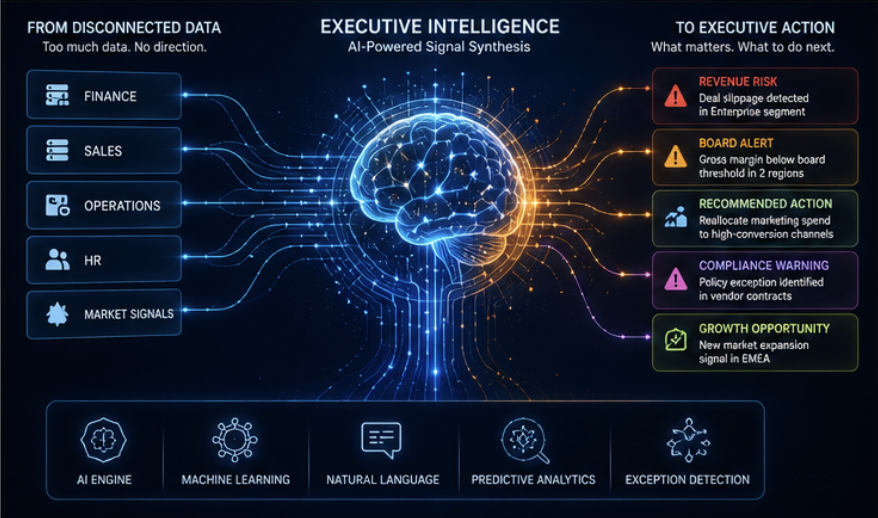
A dashboard showing a 12% revenue variance is informative. An intelligence layer that identifies which three accounts drove that variance, flags the credit risk in two of them, and surfaces the pipeline coverage needed to recover it by quarter-end is actionable. According to Deloitte's State of Generative AI in the Enterprise, Q4 2024, only 22% of organisations report that their current analytics tools produce outputs that directly inform executive decisions without additional analyst interpretation.
Frequently Asked Questions
What are executive intelligence tools?
Executive intelligence tools are platforms that aggregate data from multiple business systems and synthesise it into role-specific signals for senior decision-makers. Unlike standard BI tools, they prioritise exceptions and recommended actions over historical summaries. They are designed to reduce the analyst workload between raw data and board-ready output.
How much do enterprise board reporting tools like Palantir cost?
Palantir Foundry typically requires an annual commitment in excess of $500,000, with implementation costs adding significantly to the total. Mid-market and growth-stage organisations often find the total cost of ownership exceeds the value delivered in the first 18 months. Alternatives exist that deliver comparable signal synthesis at a fraction of the deployment cost and timeline.
How do CFOs reduce board reporting preparation time using AI tools?
AI-powered executive intelligence platforms can automate data ingestion, exception identification, and narrative generation — reducing the analyst hours required to produce a board pack. According to McKinsey's The State of AI 2024, organisations using AI at the decision layer report a 40% reduction in time spent on recurring reporting cycles. The key requirement is a platform that connects to existing data sources without requiring a full data migration.
What data sovereignty options exist for financial services boards using AI tools?
Financial services organisations and regulated entities should prioritise platforms that offer on-premise or private cloud deployment, ensuring data does not transit third-party infrastructure. Several tools on this list, including Qlik Sense and Snowfire AI, support this deployment model. Cloud-native tools like Domo and ThoughtSpot may require additional contractual controls to meet data residency obligations.
How can founders use executive intelligence tools to prepare investor reporting?
Founders preparing board packs for investor reporting need tools that surface forward-looking signals, not just historical performance. Platforms with AI synthesis layers can generate the narrative context around metrics that investors expect — covering pipeline health, burn rate trajectory, and milestone progress — without requiring a dedicated analyst resource. The speed of insight generation matters most during fundraising cycles when reporting timelines compress.
How does Snowfire AI compare to Palantir Foundry for board reporting?
Palantir Foundry offers deeper data engineering capability for large-scale enterprise environments but requires significant budget and a 9-to-18-month implementation runway. Snowfire AI is designed for organisations that need board-level intelligence live in 30 days, with a private deployment model that satisfies data sovereignty requirements. Same edge. Minus a zero.
What should a CRO look for in an executive intelligence tool for pipeline reporting?
A CRO needs a tool that connects CRM data to board-level pipeline visibility without manual exports or analyst dependencies. The platform should surface bottlenecks by stage, flag at-risk deals by signal rather than by rep input, and produce a forward-looking revenue projection that holds up under board scrutiny. Role-based visibility ensures the CRO view is distinct from what the CFO or CEO sees in the same system.
Sources
Related articles
Where Is AI Actually Worth the Investment?
See where AI could create value in your business. Snowfire Transform builds a personalized assessment, estimated ROI, and 90-day roadmap in about 30 seconds.
Read article →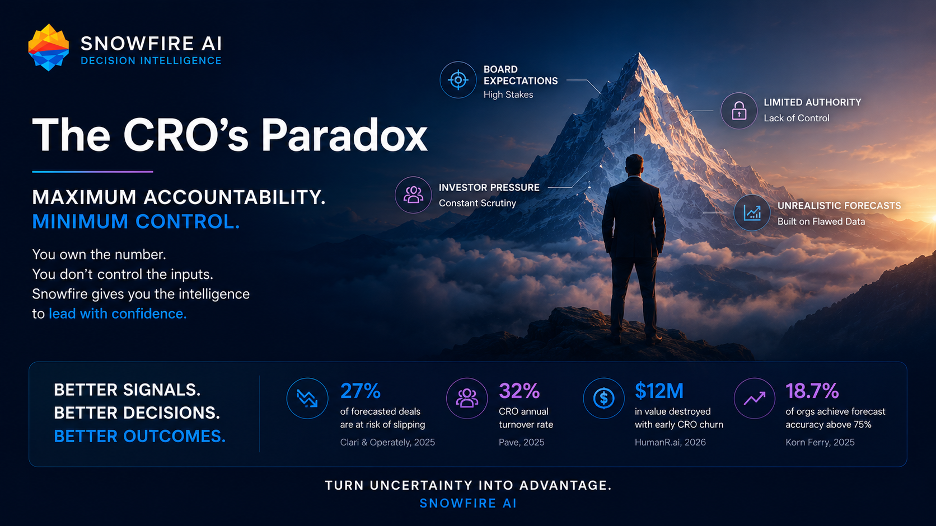
The CRO's Paradox
CROs carry full revenue accountability with fragmented authority, unreliable CRM data, and channel blind spots — why the most scrutinized executive is also the most structurally handicapped.
Read article →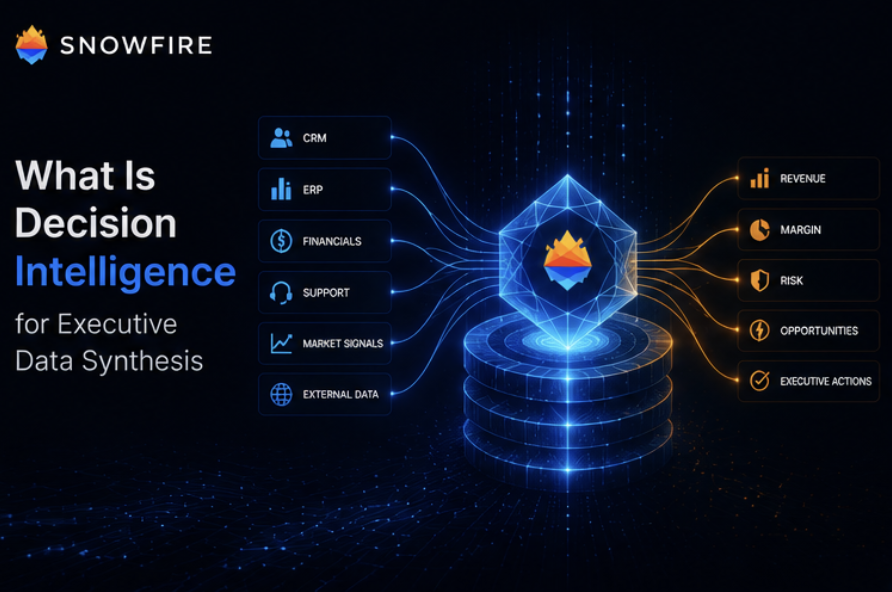
What Is Decision Intelligence for Executive Data Synthesis
Decision intelligence converts organisational data into prioritised, executable recommendations—replacing manual analysis with structured AI reasoning mapped to business outcomes.
Read article →