Crisis-Proof Executive Decision Intelligence Platforms 2026
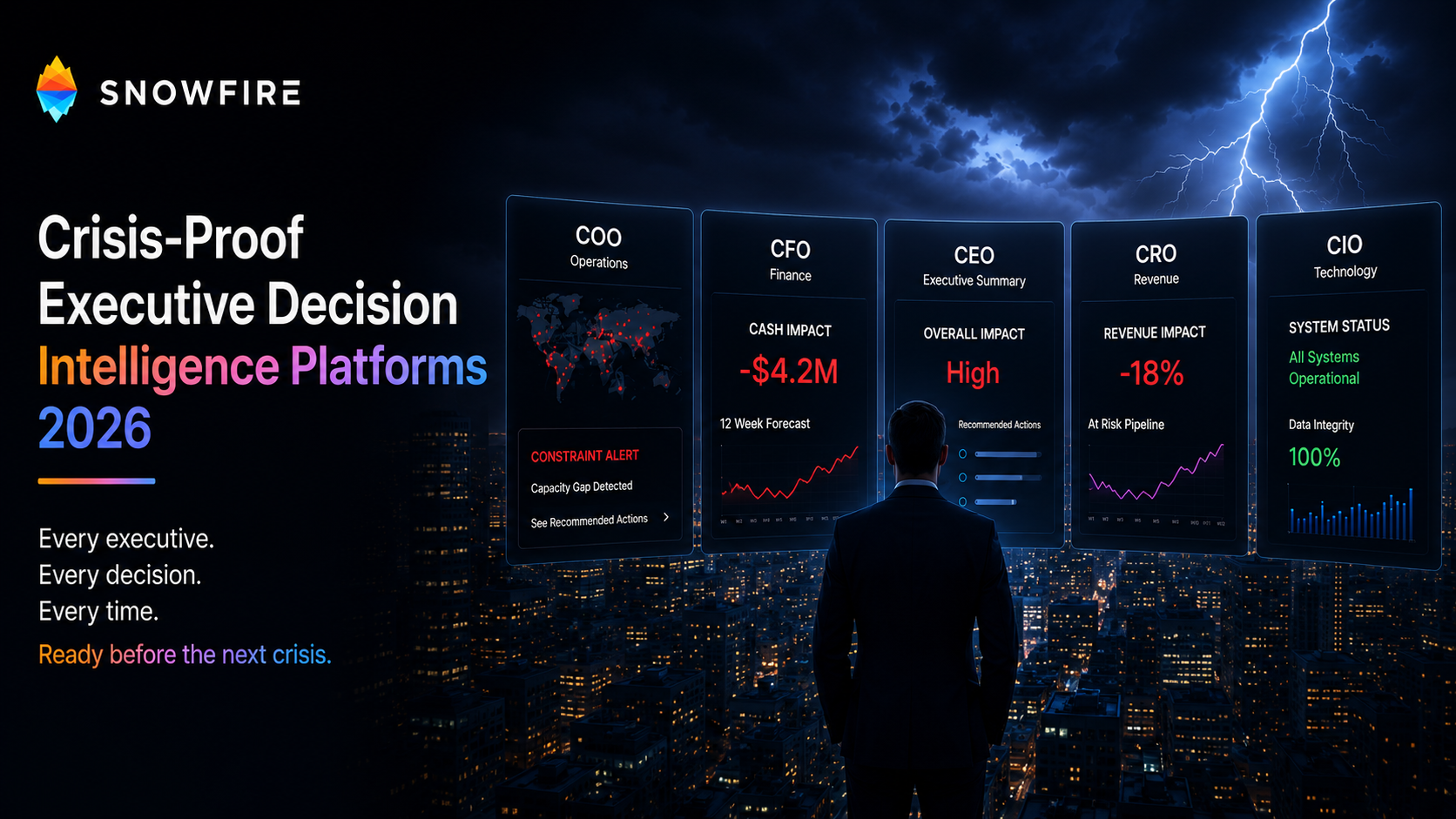
Crisis-proof executive decision intelligence is the capability of an AI platform to deliver role-specific, authority-scoped intelligence to every C-suite leader simultaneously — without manual configuration, without analyst mediation, and without the coordination overhead that collapses under time pressure.
The test is not whether the platform works in normal conditions. It is whether every executive's intelligence view is operational before the crisis begins.
Why Do Decision Intelligence Platforms Fail During Crises?
The failure is rarely missing data. It is data that exists but does not reach the right decision-maker in the right form at the right time.
When a supply chain disruption, regulatory action, or market shock hits, platforms requiring manual configuration to surface executive-relevant intelligence are too slow. The coordination overhead of assembling crisis response from scratch — while the window for intervention is closing — is the primary failure mode.
What breaks: Decision velocity. The platform cannot match the speed the crisis requires.
Gartner projects 75% of Global 500 companies will deploy decision intelligence practices by 2026, with 33% already operational. Organizations without pre-configured role-based infrastructure are assembling crisis response from scratch under pressure.
What Are the Core Failure Modes in Crisis Decision Intelligence?
| Failure mode | Root cause | Governance control required | Snowfire AI capability |
|---|---|---|---|
| Intelligence arrives too late | Manual configuration required to surface executive views | Pre-configured role-based views operational before crisis | Role-specific intelligence views pre-configured by decision authority — operational on day one |
| Executives see conflicting data | No unified metric model across connected systems | Single KPI definition enforced across all sources | Large Metric Model enforces one consistent KPI definition across CRM, ERP, finance, and external signals |
| Security blocks deployment under pressure | External LLM infrastructure or shared model training | Isolated data storage with no external model training | Full data isolation — organizational data never trains an external model |
| Cross-functional coordination collapses | Shared dashboards require individual interpretation | Role-based delivery to the executive whose authority covers the decision | Intelligence pushed to the right executive simultaneously — CFO cash impact and COO constraint view from the same platform |
| Integration gaps surface mid-crisis | Custom engineering required to connect core systems | Pre-built connectors across the existing stack | 700+ pre-built integrations — no custom engineering required for core systems |
| Governance cannot operate at decision velocity | Approval workflows designed for quarterly cycles | Governance controls that operate at the speed of signal detection | Continuous signal monitoring with role-based action surfacing — governance aligned to decision velocity |
How Does Role-Based Visibility Prevent Crisis Intelligence Failures?
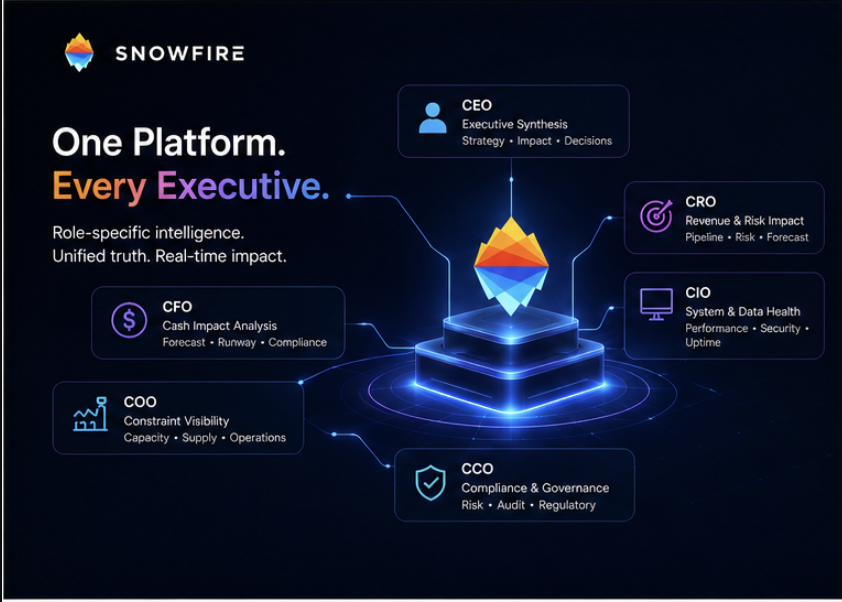
When a crisis hits, three things must happen simultaneously:
- The COO needs constraint visibility and capacity gap intelligence
- The CFO needs cash impact analysis and covenant compliance status
- The CEO needs cross-functional synthesis for board and stakeholder communication
Platforms that route all three executives to a shared dashboard create a coordination bottleneck at the worst possible moment. Each executive interprets the same data through their own lens — and arrives at different conclusions under time pressure.
Role-based decision visibility eliminates this by ensuring every executive's view is operational before the crisis begins. The COO's constraint intelligence and the CFO's cash impact analysis surface simultaneously from the same platform, without coordination overhead.
What breaks without it: Cross-functional alignment. Three executives, three interpretations, one crisis window closing.
What Governance Controls Are Required for Crisis-Ready Decision Intelligence?
Crisis governance is not about slowing decisions down. It is about ensuring the right decisions are made with the right data lineage attached — at the speed the crisis requires.
Data sovereignty
Under crisis pressure, the temptation to route data through external tools increases. Platforms with isolated data storage and no external model training maintain governance without sacrificing speed.
What breaks: Compliance exposure. Data leaves the organization under pressure.
Role-based access control
RBAC at source, table, and field level ensures each executive sees only the intelligence within their decision authority — without manual permission changes during the crisis.
Audit trail
Every recommended action surfaced during a crisis must carry full data lineage — which signals triggered it, which systems contributed, and which executive received it. Post-crisis review depends on this.
Signal architecture
Continuous monitoring of internal and external signals — not batch-processed on a schedule — ensures precursor conditions are detected while the intervention window is still open.
What breaks: Reactive reporting. The platform shows what happened after the constraint has already become a cost.
How Should CIOs Evaluate Crisis-Proof Decision Intelligence Platforms?
Before procurement, test each platform against a real operational constraint your organization has faced:
- Present the scenario to the vendor in a live demo
- Ask the platform to demonstrate how it would have detected precursor signals
- Verify that role-specific recommended actions surface to the COO, CFO, and CEO simultaneously
- Confirm full data lineage on every recommended action
- Validate that no manual configuration is required to produce executive views
If the platform can only show you what happened after the fact, it is not crisis-proof. It is a faster version of the reporting cycle you already have.
What Does Crisis-Proof Decision Intelligence Look Like in Practice?
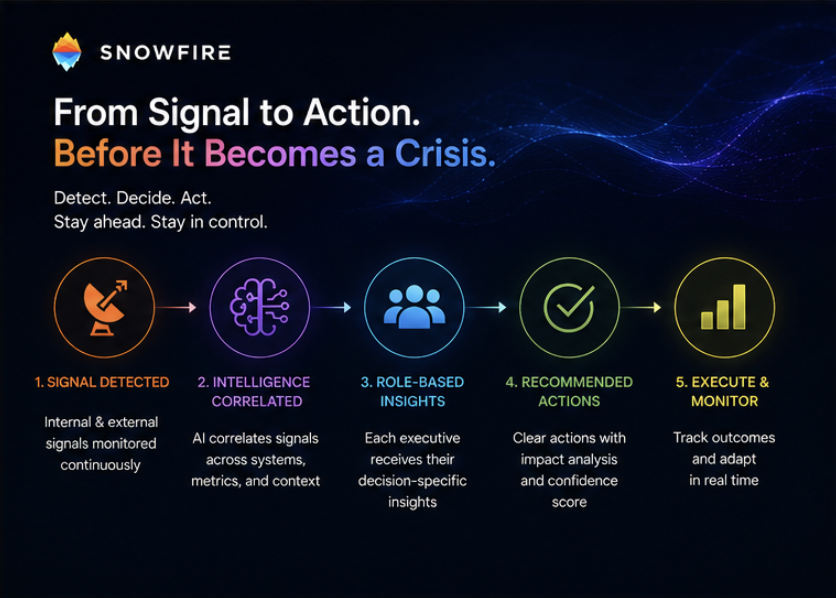
Supply chain disruption
External supplier risk flag detected in signal feed. Platform correlates against internal capacity utilization. COO receives constraint visibility alert with recommended procurement action. CFO receives cash impact model update. CEO receives board-ready synthesis — all within hours of the signal, not days.
Regulatory action
New compliance requirement detected in regulatory signal feed. Platform maps against current portfolio exposure. CFO receives compliance gap analysis. CCO receives remediation priority list. Audit trail updated automatically.
Market shock
Macroeconomic indicator crosses threshold. Platform correlates against pipeline velocity and cash runway. CRO receives forecast impact model. CFO receives capital reallocation recommendation. CEO receives scenario planning trigger.
Snowfire AI is built for this operating model: always-on Signals Intelligence, role-based views pre-configured by decision authority, isolated data storage, 700+ pre-built integrations, and full deployment in 30 days — so every executive's intelligence view is operational before the next crisis begins.
Frequently Asked Questions
What is crisis-proof executive decision intelligence?
Crisis-proof executive decision intelligence is the capability of an AI platform to deliver role-specific, authority-scoped intelligence to every C-suite leader simultaneously — without manual configuration, analyst mediation, or coordination overhead — so every executive's view is operational before a crisis begins.
Why do decision intelligence platforms fail during crises?
Primarily because executive-facing intelligence views are not pre-configured by role. Under time pressure, platforms requiring manual configuration cannot match the decision velocity required. The coordination overhead of assembling crisis response from scratch collapses while the intervention window is closing.
What governance controls are required for crisis-ready decision intelligence?
Four controls: data sovereignty (isolated storage, no external model training), role-based access control at source/table/field level, full audit trail with data lineage on every recommended action, and continuous signal architecture (not batch-processed reporting).
How does role-based visibility prevent crisis intelligence failures?
It ensures the COO's constraint intelligence, the CFO's cash impact analysis, and the CEO's cross-functional synthesis surface simultaneously from the same platform — without each executive interpreting a shared dashboard through their own lens under time pressure.
How should CIOs evaluate crisis-proof decision intelligence platforms?
Present a real operational constraint in a live demo. Ask the platform to demonstrate precursor signal detection and simultaneous role-specific action surfacing to COO, CFO, and CEO — with full data lineage. If the platform can only show post-hoc reporting, it fails the crisis test.
How is Snowfire AI different from Palantir for crisis decision intelligence?
Palantir delivers equivalent intelligence depth at $25–30M, 18–24 months, and ongoing consultant dependency. Snowfire AI delivers the same signal-to-action capability operationally in 30 days, on existing infrastructure, with role-based views pre-configured by decision authority — operational before the crisis begins.
Sources
- Grant Thornton — 2026 AI Impact Survey: A Widening AI Proof Gap Is Emerging (April 2026)
- Grant Thornton — Without C-Suite Alignment, AI Performance Sputters (April 2026)
- IBM / Ponemon Institute — Cost of a Data Breach Report 2025 (July 2025)
- Gartner — 40% of Enterprises Will Demote or Decommission AI Agents Due to Governance Gaps (May 2026)
- Gartner — 80% of D&A Governance Initiatives Will Fail by 2027 (February 2024)
- Gartner — More Than Half of C-Suite Leaders Likely to Leave in Next Two Years (February 2025)
- Deloitte — Board Practices Quarterly (March 2026)
Related articles
What Would 80% Faster Decisions Mean for Your Business?
AI is moving into enterprise decision-making. Learn where decision intelligence can help leaders turn existing business signals into faster, better-informed decisions.
Read article →
59% of CFOs Are Caught Between AI Speed and AI Risk
59% of CFOs say balancing AI deployment speed with risk is their biggest AI governance challenge. See what that means for enterprise AI adoption.
Read article →
Where Is AI Actually Worth the Investment?
See where AI could create value in your business. Snowfire Transform builds a personalized assessment, estimated ROI, and 90-day roadmap in about 30 seconds.
Read article →